Thursday, 30 October 2025

#510: Apple a day no more...

A BBC piece a while back looked at a decision by Heineken to grub up a large area of orchards in order to sell the land.


There are a few relevant issues for the potential GCSE Natural History curriculum here.

Orchards are a lost part of the English landscape. The climate of the country is perfect for growing this crop. We used to have far more varieties of apple than we do now - and many apples in supermarkets are imported e.g. Pink Lady.

Common Ground are clear on the importance of apples, celebrating Apple Day on October the 21st.

Daniel Mason's excellent 'North Woods' is a great book on the significance of apples. The whole book is themed around an apple tree.

#509: Go Jauntly into your Naturehood

Via LinkedIn.

Go Jauntly has teamed up with the National Trust.


Monday, 13 October 2025

#508: An island as old as me

Surtsey is a volcanic island which emerged from the sea in November 1963 off the southern coast of Iceland. I have mentioned it previously on the blog as it is a large natural laboratory.

This piece in the Guardian talks about its importance as a place which has been protected from human interference for over 60 years.


In 1965, Surtsey was placed under formal protection by the government. Only researchers and the odd journalist – under strict supervision – would be allowed to visit. No sheep would ever be allowed to graze there. 

It offers hope and practical lessons for rehabilitating ecosystems damaged by war, pollution or exploitation: if space is given, nature will always find ways to return, often faster and more creatively than we expect.

#507: Hamza's Wild Isles

I enjoyed this last night and have enjoyed the other programmes.

A good introduction to some of the wildlife to be found in Britain.

I've seen many of these myself, including badgers in the Peak District, and grebe courtships, and even a Bittern at Titchwell reserve. Also heard them booming on the Broads. Interestingly I was next to the wetlands in Cardiff over the summer as well.

Hamza has had an interesting life.

You can also request a free booklet and postcards from the Open University.

My copies have arrived.


Sunday, 12 October 2025

#506: Nature connectedness

This two word phrase is likely to become increasingly important to many taking the new specification I would imagine. I would be surprised if an increase in this was not added as an outcome from studying GCSE Natural History.

Nature connectedness is intended to replace the current disconnect between young people and the natural world flagged up by a number of writers, including Robert MacFarlane.

How can this be fostered in young people?

Perhaps time spent outside?

A recent BBC News article suggested as little as 20 minutes is enough to have an impact.

Ideas welcome. How best to do this?

Image: Alan Parkinson, shared on Flickr under CC license

#505: NBN Atlas for butterfly data

Check out the atlas here for all things butterfly... 


#504: Sharing the blog on Substack

I've been sharing my blogs over on my Substack Newsletter. This comes out weekly and provides an update on blog posts, projects, news, books, images and events linked to geography.


Subscribe here.

Thursday, 9 October 2025

#503: Local Distinctiveness

Common Ground has a "local distinctiveness" section to their website.

With the increasing homogenisation of the landscape and culture and the rise of AI slop, it's important to cherish those 'local' differences which can be explored using local fieldwork.

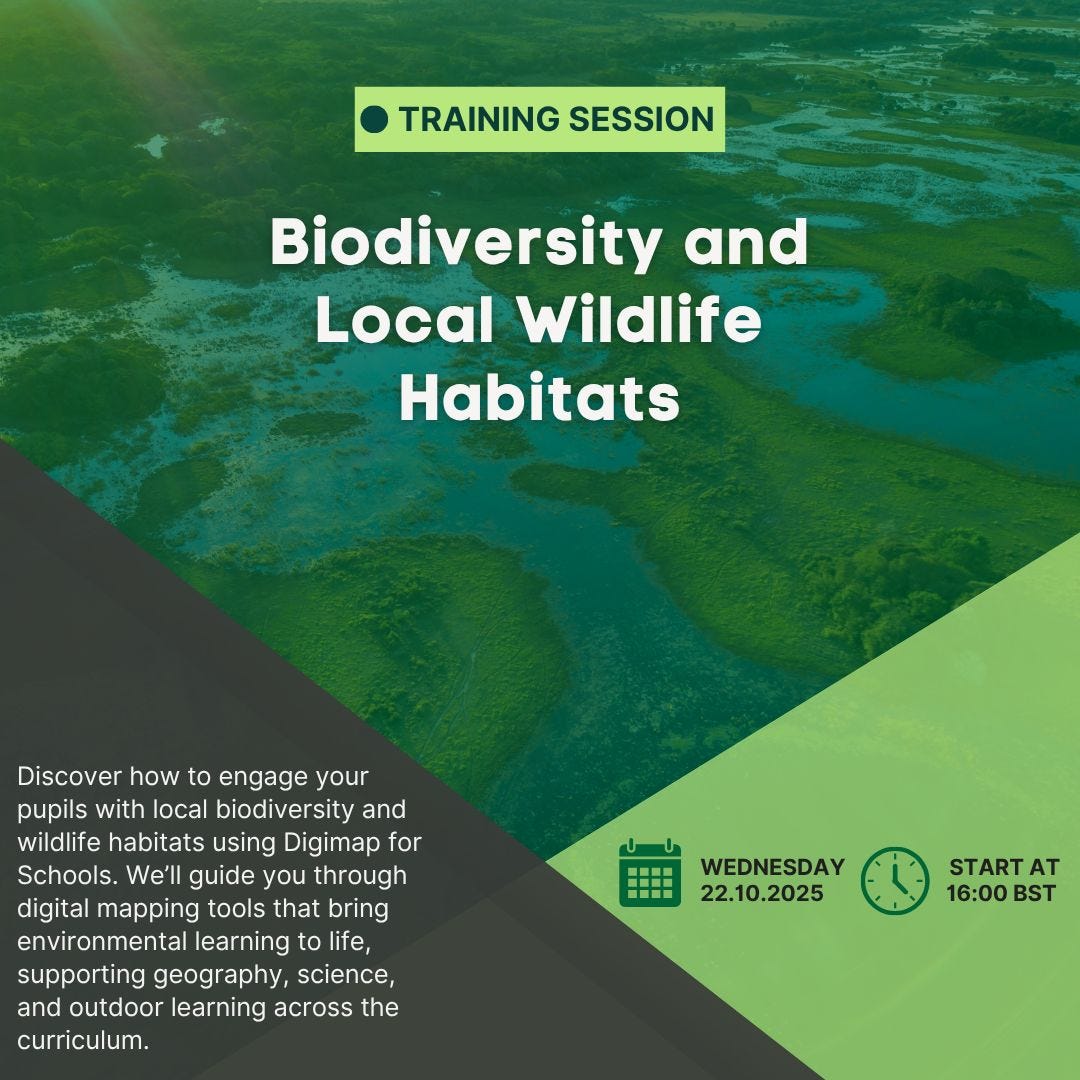
#502: Digimap CPD on mapping local wildlife and biodiversity

A free Digimap for Schools Webinar to help you explore biodiversity and local wildlife habitats. 

This sort of CPD will be valuable for those who have aspirations to teach the new specification.

No alternative text description for this image

Sign up here - it’s free.

Tuesday, 7 October 2025

#501: Green to Grey

Green to Grey tracks environmental change in the EU.


Here's the opening shots of the website which includes a wealth of information and imagery on environmental change. Would go well with Daniel Raven Ellison's 100 Seconds films.

The website has many stories and details of specific locations.
It was featured in this recent Guardian piece outlining the rate of change of the environment. We often talk about deforestation in the Amazon, forgetting that we are degrading the landscape here in Europe, and even more so in the nature-depleted UK.

Thanks to Alice Griffiths for the tipoff here.

Monday, 6 October 2025

#500: Still waiting...

When I started this blog back in January 2023 it looked like we might have a draft specification for the GCSE Natural History fairly quickly... we had had the original draft consultation and OCR were taking up the task of developing some resources and other support materials.

Image: Alan Parkinson, shared on Flickr under CC license

A new specification would need all the related documents, including sample assessment materials (SAMS), materials and training for teachers who might be considering teaching the course, a textbook perhaps and support for schools who might decide to go with a new and unknown course, compared with a subject like Geography which was well known and had all the support materials in place already (presumably). 

With the fieldwork that is going to be involved in the new qualification, this was going to need some additional thinking and this may also be one factor influencing schools given the cost of some fieldwork.

The National Education Nature Park has done a lot of work in this area promoting local and school-based work.

Still waiting then... and hoping that the next OCR Consultative Forum meeting may offer some news...  although unfortunately it's been scheduled for a day I can't make.

Friday, 3 October 2025

#499: The Boar: a timely piece

Via my Google Alert that I set up for the term 'GCSE Natural History' is a piece in The Boar by Megan Denham.

Founded in 1973, The Boar is the University of Warwick’s award-winning student newspaper and the only student-run print newspaper on campus. 
The paper is run by students, for students and all editorial board and business team positions are voluntary. With a reach of approximately 33,000 students and staff on campus, the newspaper is printed monthly during term time.


It points to a general lack of climate change mentions in the curriculum, which doesn't mean it isn't taught of course. My school doesn't follow the national curriculum along with a great many others...

On the GCSE Natural History as a possible addition, it says:

In an attempt for greater climate inclusion, a new Natural History GCSE is being introduced across the UK – the result of a campaign led by naturalist Mary Colwell. The government says: “The new Natural History qualification will enable young people to explore the world by learning about organisms and environments, environmental and sustainability issues, and gain a deeper knowledge of the natural world around them.”

On the surface, this seems to be a significant step toward integrating more in-depth climate education into secondary schools. On the other hand, the efficacy of the course relies on its uptake by students (although the research by Mental Health UK suggests that there would be many students open to learning more about climate change). The implementation of the course also requires teaching staff able to deliver the content across all UK secondary schools, and, fundamentally, it does not address the UK-wide lack of cross-curricular climate education.

#540: A thorny problem

Kenya's Samburu county has marginal land which is prone to desertification .  To try to keep it in place, they decided to introduce a t...