Showing posts with label Habitats. Show all posts

Monday, 31 August 2026

#677: WWT Welney Reserve and Peter Scott

Another location which will feature in the list of possible places to visit for those schools that choose to offer the new specification and want a fieldtrip or field visit as part of the course, perhaps to draw in some experts, or introduce students to some of the key habitats that the draft subject content has suggested should be the focus for student learning.

Welney was the second reserve created by Sir Peter Scott for the Wildfowl and Wetlands Trust.

The first was at Slimbridge in 1946.

Sir Peter Markham Scott was the son of Antarctic explorer Captain Scott who, in his dying letter, urged Peter’s mother to “make the boy interested in natural history”. He was only two years old when his father died

He also helped found the World Wide Fund for Nature, the logo of which he designed, with its panda.


Welney Reserve is close to where I work in Ely. I have passed the reserve frequently, but only visited a few times.


Monday, 17 August 2026

#652: Stone Curlew habitats and new housing

This story from the BBC News had a headline which at first glance is the wrong way round surely...

It's since been changed.

Stone curlews are a protected species. I have seen them in the wild in a field which is part of a Norfolk Wildlife Trust reserve.

I've visited Weeting Heath and seen the bird in the fields at the reserve. It's eye always draws the eye... it's a beautiful bird.

Friday, 3 July 2026

#608: Peatland restoration

Some years ago, I worked with a researcher to translate their work into the classroom. 

It was written for the RGS-IBG's From the Field project.


The work looked at how peat moorlands recovered after fires. There have been a number of fires in the Peak District and such fires are becoming more common with high temperatures and drought conditions.

Aims
Once a heathland ecosystem has been damaged by fire, it can take many years to become re-established. Like any area of vegetation, relationships become established between the plants and the animals that inhabit them, and across the trophic levels that make up the network ecology.

Rose’s work is to explore the mechanisms for the restoration of pollination, and the extent to which this has been successful over time. As an area recovers from fire, it will also move through the stages of plant succession: a process which will have been arrested by the fire.

This is essential if the ecosystem is going to recover. The restored heathland network tends to have a different structure to the ancient heathland, with fewer interactions between the plants, bees and parasites that live on the bees.


The work was funded by Goldsmiths Company.

Tuesday, 16 June 2026

#593: Wild Isles

The recently released proposed subject content references a BBC series called 'Wild Isles', which was made in association with the Open University.
This inspired the 

There was an associated book published and I've bought a cheap second hand copy so that I have it as reference for whatever resources I get involved in creating.

Wild Isles is a celebration of the wildlife found on a relatively modest collection of islands positioned at a latitude so northerly to be unattractive to many animals and plants. Despite these unpromising foundations, the islands of Britain and Ireland, together with more than 6,000 lesser islets that make up our archipelago, contain some of the most diverse, beautiful and wildlife-rich landscapes and seas on our planet. This book will explore the fascinating relationships within and between species who make their home on our beautiful isles.

Each chapter focuses on a particular kind of wild space. Britain and Ireland are dominated by a wide variety of grasslands from lowland water meadows to upland moors, and we will see how these human-shaped, semi-natural landscapes thrum with insect, bird and mammal life. Life requires water to flourish, and streams and rivers carry freshwater through our landscape, creating unique ecosystems and interrelations within and beside these waters, which are revealed in a third section. While Britain and Ireland's woodlands are comparatively thin on the ground compared with most of continental Europe, we will see some of the forests and trees that remain are unusually ancient and, great repositories of life. Finally, of course, we are surrounded by sea, and our position on the continental shelf before it plunges into the depths of the Atlantic Ocean gives rise to an often overlooked plenty of marine life. A glorious richness divided into five breathtaking sections.

The book has inspired the choice of habitats in the proposed subject content, from which awarding bodies will have to develop worked examples and sample wildlife (flora and fauna) for students to engage with.


There was also a separate OU booklet which I requested at the time, and is added to my list of resources.


Thursday, 30 April 2026

#569: Jane Goodall - someone to mention

We recently lost a real hero of Natural History: Dr. Jane Goodall.

She had spent her life speaking about the need to conserve nature, and habitats, particularly for primates. 

There are many quotes which are attributed to her, where she shows the true value of connecting with nature.

She also recorded a Netflix special interview for "Famous Last Words" which she said could only be shown after her passing and in this she named the people she thought were having the greatest impact on the natural world through the actions of their companies or political decisions. 

Who would be on your list of people to mention as part of a GCSE Natural History specification??

Let me know in the comments.

Saturday, 14 March 2026

#556: RSPB - a fieldtrip option, and citizen science opportunity

The RSPB is one of the supporters of the new GCSE in Natural History. 
A list has been blogged previously showing the original supporting organisations. 

The connections which are made clear when the draft subject content emerges for consultation will be helpful in providing a steer for the approach that has been taken.

There are quite a few RSPB reserves around the country.

It is one of the largest conservation organisations in the country, and has many members. They have also been particularly critical in the last six months of changes in government policy around planning, which was a rare foray into this sort of campaigning work.

They also have a role in education, and could well provide a useful option for schools needing local fieldwork opportunities, or training, or perhaps to provide a role for certain students. 

There may well be some ornithological experts amongst the student body of any school - although the Merlin ID app is a useful alternative to actually recognising bird song.

RSPB reserves welcome visitors of course, and they also have an Educational 

The RSPB website is here.

RSPB members can access reserves and car parks. It is a good value membership given the number of reserves that can be visited.

Thursday, 9 October 2025

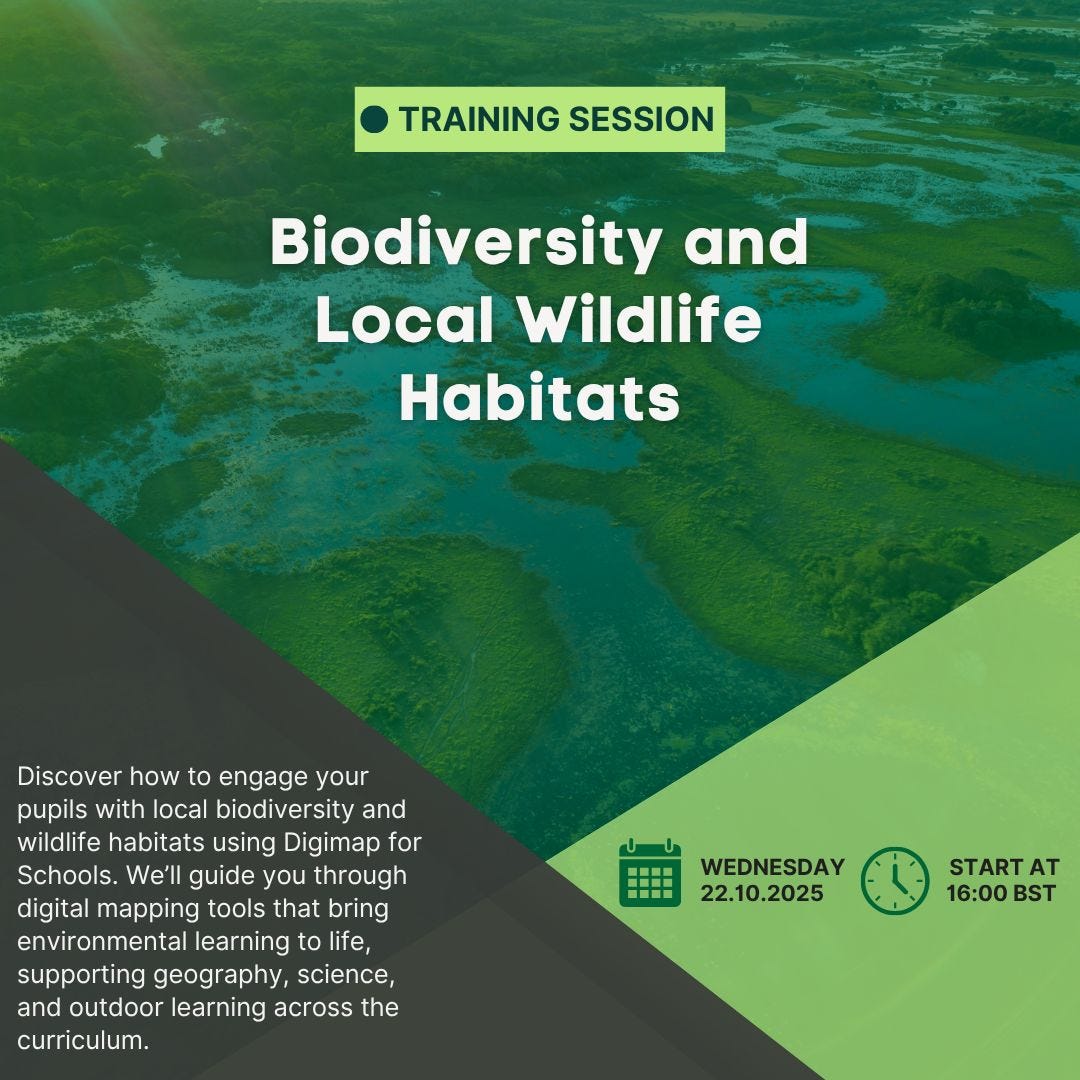
#502: Digimap CPD on mapping local wildlife and biodiversity

A free Digimap for Schools Webinar to help you explore biodiversity and local wildlife habitats. 

This sort of CPD will be valuable for those who have aspirations to teach the new specification.

No alternative text description for this image

Sign up here - it’s free.

Tuesday, 7 October 2025

#501: Green to Grey

Green to Grey tracks environmental change in the EU.


Here's the opening shots of the website which includes a wealth of information and imagery on environmental change. Would go well with Daniel Raven Ellison's 100 Seconds films.

The website has many stories and details of specific locations.
It was featured in this recent Guardian piece outlining the rate of change of the environment. We often talk about deforestation in the Amazon, forgetting that we are degrading the landscape here in Europe, and even more so in the nature-depleted UK.

Thanks to Alice Griffiths for the tipoff here.

Friday, 8 March 2024

#256: Fieldwork resources - every Friday

Chloë Searl is an independent field studies tutor on the Isle of Wight. She also works as a CPD consultant, examiner and award-winning resources writer. 

She is also the current Chair of the Fieldwork and Outdoor Learning Special Interest Group of the Geographical Association. 
You can follow their Twitter feed on the link below.
@GAFOLSIG

Each Friday she shares a resource linked to fieldwork, and several of these have the potential to be put to use to those teaching the GCSE Natural History. This week's resource is a useful sheet that can be used to assess the human impact on ecosystems and habitats in an area.


Saturday, 24 February 2024

#246: Ditches

A very nice piece by Melissa Harrison in The Times on the 4th of November 2023 looked at the important role that ditches play in the landscape. This was followed up by a range of tweets on the value of ditches.


There is a tendency to focus on the grand elements of the landscape, but sometimes the smaller overlooked features are just as important for the wildlife that makes them a home: think about the rare ferns and other plants that thrive in the grykes on limestone pavements for example.

 Image: Fenland roads - Alan Parkinson - shared under CC license

Thursday, 22 February 2024

#242: MAGiC Map - a free resource for GIS work

MAGiC is an interactive map. It is produced by DEFRA with a range of other organisations.

The GI stands for Geography Information - it's a GIS.

There are a series of layers of information which can be added to the base map.

Here's a map made by turning on the Habitats > Coastal > Saltmarshes layer, for example. This is very easy to do and students could be asked to explore the map themselves or be given a step by step guide. It would make sense

This map shows the locations of saltmarshes around the Wash.


Similar maps can be created for a whole range of habitats by changing the overlays.

A general guide to the map is available here.

Tuesday, 5 December 2023

#198: Tree Equity Score

Not all areas have equal access to trees: urban concrete jungles can be tree depleted compared to rural areas. Trees provide all sorts of benefits which are fairly obvious, and hopefully the GCSE Natural History will help raise a new generation of dendrophiles, who love trees and the impacts they have on an environment: aesthetically, as well as with respect to air quality improvements.


The map was released earlier in the week, and this article on the BBC News explores the work being done in one Sheffield school to plant trees to improve air quality.


The area where my school is scores 81. The tree cover is 11% apparently. What can schools do to help up the canopy? Time till tell...


Sunday, 12 November 2023

#173: Habitat Explorer

This is connected with the new series Planet Earth III - which will not be so new by the time the new specification gets off the ground.

It's an interactive called Habitat Explorer.


Habitat Explorer lets you bring amazing animal habitats into your own living room. When you've scanned the QR code just choose the habitat you want to explore and point your camera at a flat, horizontal surface. Tap where you want it to appear and start exploring!

You can zoom in, spin it around or even move around the space and get up close to the animals in their environment.

Don't forget to create your own pledge cards and share on social with #OUHabitatExplorer.

Friday, 13 October 2023

#122: Canal and River Trust

The proposal documents for the new Specification list a number of supporting organisations. This is one of a series of posts exploring these organisations and what they might offer for those teachers who are thinking about offering the new specification and qualification in their schools and institutions.

It would also make sense to check out what the options are for your nearest stretch of water. I am fortunate to 


The Canal and River Trust is involved in the management of the nation's waterways.

The website also features a section on invasive species.


Scroll to the bottom and you can see a nice representation of what they believe rivers can look like...


These are worth looking at for a whole range of natural history related reasons. They are designed for Primary in particular but there is something there to work on.


Saturday, 12 August 2023

#72: A-Z of British Trees

The Woodland Trust has produced a useful illustrated guide to British Trees.

Each entry includes:
- the Latin name of the tree
- a description
- images of the trees
- identification guide to help identify the tree and what it looks like at different times of the year.
- a guide to where the trees can be found
- value to wildlife
- uses of the wood and associated mythology and other stories
- threats to the speices e.g. ash trees are threatened by ash dieback.

A very useful guide.

#707: A requiem for Sycamore Gap

Robert MacFarlane has finished work on “The World Tree”, the libretto for a long choral work originally inspired by the felling of the Syca...