A blog providing ideas and resources for those teachers hoping to teach the new GCSE Specification, first announced in April 2022. Draft subject content released for consultation in June 2026 - for first teaching from 2028 or 2029.
Another in a series of posts on people who one would probably be worth discussing with students as part of the final course, because of their contributions to Natural History.
It remains to be seen whether this will actually form part of the final specification.
Alexander von Humboldt should have a place on any such list.
There is a very useful book on the life and work of von Humboldt by Andrea Wulf: a biography published in 2015 which won several awards.
It outlines his pioneering work in a range of sciences, including the creation of
Here's a short video from the Smithsonian which talks about his ideas, some of which were contemporaneous with other figures.
His first major expedition to South America began in 1799. It would last five years and what he 'discovered' and described there was to kick start his career.
.
& one from TED Education...
Von Humboldt was also credited with some of the early examples of infographics, which he developed.
This looks like being particularly good. I'm really keen on books like this which promise to tell the human history of physical / natural regions / biomes.
I will look to get this out of the library and add it to the blog once I've had the chance to read it.
These are ‘freaksosystems’, or Frankenstein ecosystems. For the most part, people who work in landscape design and management have the feeling that they know better than nature. They love nothing more than to create a ‘freakosystem’ of their own designing (I love this term 😂). https://t.co/fjPczCuVm0
Soil is one of the most important substances on the planet, and there will definitely be a focus on soils in some way in the final specification as the soil partly determines the climax vegetation, along with other factors.
A definition from Encyclopaedia Britannica:
Soil is the biologically active and porous medium that has developed in the uppermost layer of Earth’s crust. It serves as the reservoir of water and nutrients and a medium for the filtration and breakdown of injurious wastes. It also helps in the cycling of carbon and other elements through the global ecosystem.
The study of soil is called pedology.
Soil is also an important carbon store.
A short film on soil from the Royal Society.
Any look at Natural History will need to concern itself with the soil beneath our feet, and the rocks (parent material) that lie below that. I would imagine that the specification will refer to biomes, ecosystems and various other options which will require an understanding of the abiotic and biotic components.
Soil is made from four ingredients: weathered rock, organic material, water and air.
Soil is a nutrient store and is featured on Gersmehl diagrams of ecosystems.
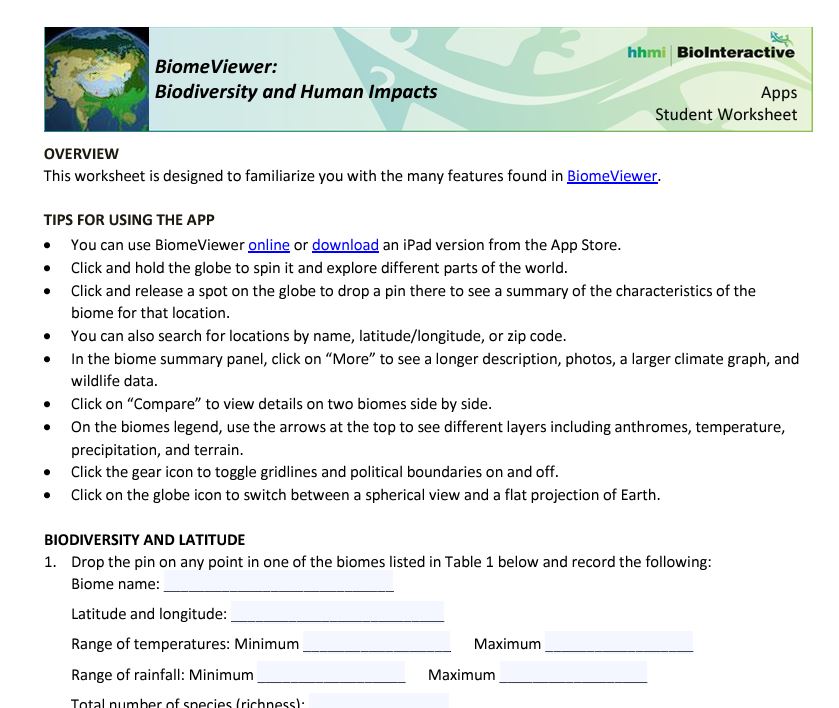
It's really useful for identifying biomes in a general way, and rotating the globe to see where they are located and identifying their characteristics.
There are accompanying resources in a folder, student worksheet and apparently an iOS app too.
The worksheet takes students through the various features which are built into the app.
A useful diagram to introduce to students. The Biome Pyramid arguably represents a stable state, and we are no longer in such a stable state.
One might discuss how biome integrity will be changed with climate breakdown and changing demands on ecosystem services. The impact of people on the desertification of marginal land in North Africa would be one example...
Tanya describes her Concentrates of Place as a ‘deliberate way of honouring places and people.’
The project resonated with me, and as a geographer I am so interested in place. I also love the idea of collecting little pieces of a place and putting them in a tin for safekeeping, and I figured if I loved this idea my students would as well.”
Shadrick drew on memories from painful events in her life to develop the idea of capturing a place within a tin.
The idea of canning 'ideas' or intangible products reminds me of items such as this, which I purchased from Margate's Crab Museum recently as a novelty item.
Mostly because I couldn't afford to buy one of Piero Manzoni's cans which contain something a little less fresh.
It's also a reminder of one of the missions in the first Mission:Explore book, which invited people to sell the smell of a place.
This was incorporated into some resources from National Geographicsome years back. It was really a privilege to work with National Geographic on several resources themed around Geography Awareness Week. We also produced a special Sustainable Seafood version of Mission:Explore Food and an entire booklet aimed at the week itself with special missions for exploring the neighbourhood.
They are still available on the website.
How about canning a particular biome or environment?