Tuesday, 14 April 2026
#567: Natural History Reading List #24: "Landmarks"
Sunday, 12 April 2026
#562: New from Robert MacFarlane
Here are the details from the film maker:
In 2020, during a lock down that marked us all, I discovered The Lost words book. This illustrated object simply celebrated words that qualified the nature around me in northern Europe. These words were blue bell, fox, badger, willow, conker, magpie, raven...The philosophy behind The Lost Words - between grief of disappearance and creative action - became something I wanted to bring to the screen; It is there that I found hope.
Sarah Konrath's (Indiana University) studies show that the level of empathy in younger members of the earth's population has gone down by 40% in the last ten years. Considering the easy access to the hard truths of a world in crisis, this is not surprising. Furthermore, when looking at documentaries that warn of the state of our planet, we quickly notice that catastrophe is written into the fibre of each film, warning and debilitating. The kindness in The Lost Words was what struck me; and its kind but subversive approach is what gave me the desire to make a film that invites us to change our point of view on our position as interconnected earth dwellers.
This is not a film about the book, but a film inspired by its creative and hopeful gaze. It is in this aesthetic of care that Lost For Words inserts itself; holding out a hand to the human and more-than-human.
Friday, 5 September 2025
#491: Ancient Woodlands
In Britain, an ancient woodland is defined as:
"an area of woodland that, through documentary, archaeological or botanical evidence, can be shown to have been in existence before 1600."
This was a time before the widespread planting of trees began. The pervasiveness of planting makes it less likely to be sure that the wood predated 1600.
Few of these ancient woodlands will date back to the original wildwood: the arboreal canopy that flourished as the glaciers withdrew from the country.
Are there any near where you live?
Image: Wistman's Wood - ancient woodland in Dartmoor - Alan Parkinson - shared on Flickr under CC license.
Monday, 4 August 2025
#481: ETP - Endangered, Threatened and Protected Species
Saturday, 11 May 2024
#308: Word of the Day: Depauperate
One aspect of preparing for the new course will be to learn a whole range of new natural history vocabulary.
This may come from a whole range of sources, including an approved textbook which is no doubt taking shape somewhere.
Others may include lectures. A recent GA Tyne and Wear Branch poster featured the word depauperate in the details of a lecture on ecosystems. I'd never heard of it before..
Turns out it will probably be quite useful when describing some urban environments.
Sunday, 15 October 2023
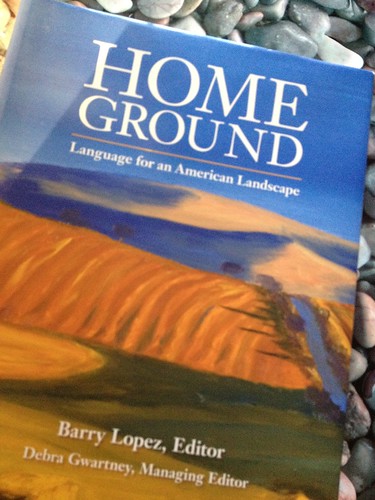
#125: Natural History Reading List #9: 'Home Ground'
I am sure that many of the terms are also relevant to the UK's diverse landscapes.
The book was compiled and edited by the late great Barry Lopez and his partner Debra Gwartney.
Around 100 pages of the book can be read on Google Books here.
The book has definitions of landscape terms - some of which will perhaps be unfamiliar to non-geographers, and not all of which can be found in the UK.
This is a rather wonderful book.It is a 'dictionary' of features which make up the landscape of the United States.
Many of the landscape terms are illustrated and accompanied by short essays from a range of contributors along with quotes. This is much better than the typical A-Z because of the eclectic nature of the articles and essays and the quality of the writing and illustrations.
Published in America, but available from Amazon.
My copy was published by Trinity University Press in 2006
Hardback, 450pp
ISBN: 1 - 59534 - 024 - 6
Thursday, 20 July 2023
#58: Urban jungles
Biodiversity isn't just found in the countryside. There is a great deal of biodiversity in many cities. In fact some may be more biodiverse than the surrounding countryside which may have a monoculture of particular crops.
The designation of London as the world's first National Park City shows that there is plenty of wildlife in cities as well, and this was at the heart of the original campaign - developed by Daniel Raven Ellison.
Here is the Natural History Museum's definition of biodiversity.
This is a term which students may be asked to engage with, and certainly be prepared to define the word itself.
Cities and towns have a smoothing effect on biodiversity, tending to favour generalist species like feral pigeons. Those that require a particular habitat, or are intolerant of disturbance or pollution, often can't survive. This is called biotic homogenization.Animals and plants that can only live in one small area of land - like unique butterflies or flowers - can go locally extinct if the city's conditions are unfavorable to them.
Image - detail from the London National Park City map of green spaces.
You can obtain your own copy of the map from here, priced at £9.99
Tuesday, 13 June 2023
#42: Defining Biodiversity
Biodiversity is a key word within the glossary of key terms that will no doubt form part of any set of resources for the new specification. Teachers and students will need to get to grips with the vocabulary around Natural History, where some words may have slightly different meanings or emphases compared to geography or science.
I have put together a list of suggestions for this already as part of the proposed resources that I am working on and compiling in Google Drive. It's already looking quite impressive.
Here's a suggested definition from the Natural History Museum.
Wednesday, 4 January 2023
#4: How are we defining Natural History?
An OCR Hub contribution which was added in April 2022 provided a definition of Natural History - there will be many different definitions of course, just as there are many definitions of geography.
It is important that all students have a clear understanding of the subject and what they will be learning about.
Definition of Natural History.
It's important to nail down what the people behind the GCSE in Natural History think that Natural History is, as definitions may vary from person to person.
Here's what is suggested in the initial documents that were released in April 2022. This may well change during the process of finalising the specification.
"Natural History focuses on understanding the rich and diverse natural world. Through observational study (generating systematic records of direct and indirect observations, often made over long periods of time) and investigation, natural history seeks to understand the diversity, complexities, and interconnectedness, of life on earth in contrasting habitats. Natural history explores how our natural world has been shaped, and how it continues to change, both by natural processes and through human intervention"#678: RGS School Member Lecture
School Membership of the RGS is just £50 a year now... half price from where it was last year. It provides a range of benefits for schools,...