Thursday, 23 July 2026

#635: Getting ready

I mentioned the podcast with Mary Colwell in the previous post.


In this podcast she describes her thoughts on when it should be launched..

I’m absolutely convinced it should be launched when it’s ready to be launched. And much as after this long and rather torturous journey, it looks like now being a reality, I think it would be a great mistake to rush it through. I think what we need to do is get everything right. We need to get really good textbooks written.

We need to get really good support materials out to teachers. I would love to see a whole bank, a sort of library of the country’s greatest naturalists giving lessons on whatever turns up in the syllabus. So you’d have Tim Birkhead talking about seabirds. You know, you’d have the perfect people to teach young people about whatever is in the syllabus.

Now, that’s gonna take time, and that will take time to develop well. I think let’s now take our time, get it right, get schools feeling confident and teachers feeling confident that they’re supported enough to teach it, and then we launch it out onto the world.

If it’s rushed through, it has the danger of being a little bit shoddy, a bit insubstantial. It won’t fire the young people’s imaginations about what natural history is. The biggest problem we have is that most people have forgotten what natural history is. They think it’s about climate change and sustainability. We’ve forgotten that it’s about animals and plants, creatures. It’s about the living world around us and knowing that living world intimately, and that takes time to develop those materials because they’ve been lost. They need to be brought back together again and presented in exciting and enticing ways that make natural history such a relevant subject going forward in their lives.

She goes on to say:

I would love to see a greater connection between natural history, as in the studying the subject, and the connection out to all the other parts of life. All the art, the music, the poetry, the literature, the history, the geography, the mathematics. Everything that we do can be traced back to nature, can be traced back to the forms, the sounds, the sights, and the wonder of the natural world.

And the more that nature is put into this much broader context of the human experience of being a living, breathing mammal in this extraordinary planet, the more we can make our relationship with nature evident everywhere in our drama, in everything that we do, then I think that will just slowly build the awe and wonder, which is what sustains all of life.

Caroline Lucas also describes access to green spaces...

We know that access to green space in England and Wales is hugely unequally spread, and we know that people from lower income backgrounds, people from ethnic backgrounds and so forth, are far less likely to have access to green space.

So it feels to me that we need to do far more to make sure in the development and planning space that we build in access to green space right from the start.

#634: A podcast with Caroline Lucas and Mary Colwell

Shared by the Green Alliance.

After more than a decade of campaigning, a natural history GCSE for England is finally on the table. In this special episode, former MP Caroline Lucas and conservationist Mary Colwell sit down to unpack the government’s new consultation: what it gets right, what it’s missing and what bumblebees have to do with it.

A new Podcast with Mary Colwell.

A transcript is available.

Mary's views on the consultation document:

Yeah, there’s lots to welcome about it actually, and from earlier iterations it’s hugely improved. So it really has shifted, um, the focus back onto studying nature, which is really accessible to you, and I think that is the most important thing. The GCSE has to be grounded in localism. It has to be the nature you see on a day-to-day basis. Now, that might not be puffins and dolphins. It might just be, uh, the worms in your garden, the butterflies, the bees, the street trees, the flowers that grow up in the streets in the springtime. It might be the everyday stuff, but that doesn’t mean it’s lacking in wonder. And so to put the emphasis back on what people will see every day is really good.

I welcome the sense of wanting to be a naturalist has come through a lot more strongly. But where I’d say it was lacking is in two or three areas. One is in the keeping of field notebooks and jottings and recordings, actually physically committing down on paper or electronically your thoughts, your observations, your data.

That’s not explicitly put in there as part of a requirement for the GCSE, and that is so important. There is not a naturalist who has ever lived that hasn’t kept a notebook. And notebooks are not only places to write numbers down, they’re places where you express that connection that we were talking about earlier, which is so important.

They’re places where your interaction, your relationship, personal relationship with what’s before you is recorded, and that psychological process sets in train a whole lifetime of connection. The other thing that’s missing, I think, is a sense of the shifting baseline. And I think until we understand that some of the greatest losses in UK nature has happened within living memory.

In the last 100 years, we have lost 50% of the mass of wildlife in the UK. Until we know that, we won’t make sense of what’s before us now. And that shifting baseline, that sense of "this is normal". You look out of the window and this is what’s normal because this is what you see, as opposed to if you’d looked out of the window 50 years ago, you’d have seen a very different world.

But we just gradually get used to less. We gradually get used to an impoverished world. And so if they could put in some way of tackling the shifting baseline in a way that younger people could talk to the older generation, it could be members of their family or their community. What was it like here 50 years ago?

Listen to it here...

#633: Europe's soils are drying out...

And that is not good news...


Rivers are running low across Europe, cutting the generation of clean hydropower and restricting cargo ships. The Rhine at Lobith in the Netherlands is now lower than the minimum level seen in the hot summer of 1976. The scientists warned that this disruption could push up the price of food and energy, hitting low-income households hardest.

The original research is here. 

Wednesday, 22 July 2026

#632: Cambridge Zoology Museum

As part of the resources which are being developed in due course to go along with the GCSE Natural History specification, we will be suggesting lists of places to visit as part of the wider work of delivering the new course. It will be important to connect students with these places, whether through school, or by encouraging parents to consider taking their children there for enrichment purposes.

As I teach in Cambridgeshire, this would be one place to consider should my current school decide to offer the new GCSE Natural History specification.


The website is here. 

#631: Our Broken Planet - now up to ten episodes

The Natural History Museum's Our Broken Planet Podcast has been going for over 2 years now. I posted about it when it had just started, so it's worth revisiting to see what topics have been covered in that time.


The most recent episode looked at what action had been taken about climate change.

Surveys show that most of us are really worried about climate change and we want something to be done. But what?

This series, we’ve explored many ways in which nature is changing in response to human activity and the dangers posed to people and planet as a result. In this final episode, Tori and Khalil explore how people are taking action in the face of the planetary emergency. Along the way, you’ll find out:When has activism been effective?
How do scientists feel about climate change?
One thing everyone can do to start making a positive change

Contributors:Dr Erica McAllister - Senior Curator for Diptera and Siphonaptera (flies and fleas) at the Natural History Museum
Professor Tristram Wyatt - Senior research fellow in the Department of Zoology at the University of Oxford and Honorary Research Fellow at the Centre for Biodiversity and Environment Research
Alessandra Korap Munduruku - Member of the Munduruku group of Sawré Muybu, an indigenous territory in northern Brazil, and President of the Pariri Indigenous Association
Dr Rim Saab - Social psychology lecturer at the University of Sussex, who specialises in the psychology of political action

Tuesday, 21 July 2026

#630: Insectageddon

A page from the current issue of the 'Geographical' magazine on the decline in insects which spells trouble for many ecosystems as they a crucial part of the food web.

I have a subscription to this magazine, and it would be a useful source for those planning to teach GCSE Natural History.


#629: Youth Climate and Nature Panel

The Youth Climate and Nature Panel is a new initiative from the Department for Energy Security and Net Zero (DESNZ) putting young people’s voices at the heart of climate and nature policy.


We are looking for passionate young people from across the UK who want to help shape the future of climate and nature policy, share their views, and inspire wider action.

The panel will bring together young people aged 16 to 25 from across the UK, representing a wide range of backgrounds, experiences and perspectives to: 
  • provide insight and advice to government on climate and nature policies
  • support better engagement with young people
  • strengthen collaboration between different generations on climate and nature issues
  • help amplify youth voices and action across the UK
The panel is part of the UK government’s commitment to work with people and communities across the country to make sure that everyone can benefit from the transition to net zero.

Fifteen young people will be selected. Young people based across the UK aged 16 to 18 can send in applications for this exciting opportunity.

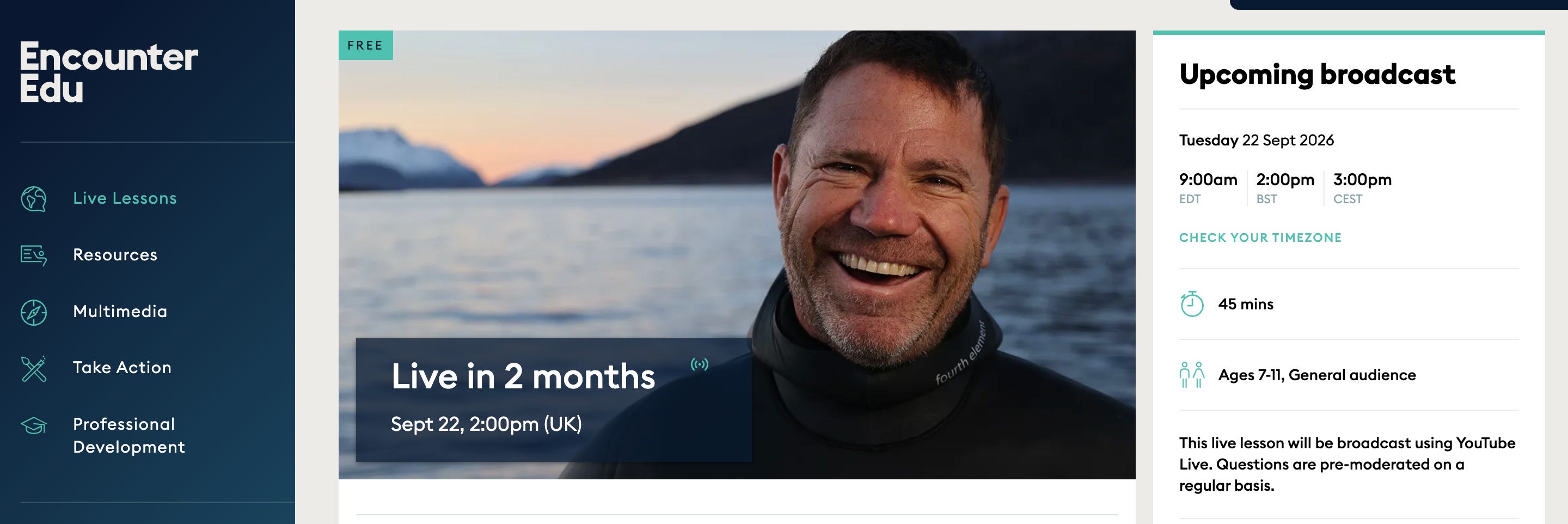
#628: Live lesson with Steve Backshall

Encounter Edu have organised a live lesson link up in September with Steve Backshall as part of Ocean Live.

The live lesson is on Tuesday 22 September, and will be pitched for ages 7-11, with all welcome to join.

We’re thrilled to launch an exciting new live lesson series, Ocean Live with Steve Backshall. Engaging young people with our ocean is one of the things Steve cares about most, and this series marks the start of a brand-new partnership with Nekton, an incredible ocean exploration charity using the latest technology to understand and protect our seas.

Join us live from The Deep on 22 September, as primary schools across the world tune in for the first broadcast.

Live from DEEP Campus, the UK’s leading underwater training and innovation centre, Steve will explore the cutting-edge technology opening up new frontiers in ocean exploration, and speak to the science team behind some incredible new species discoveries.

Expect live quizzes and interaction, segments on tech, exploration and discovery, and a full set of classroom resources and activities to extend the learning long after the broadcast ends. This live lesson will also be broadcast on Children United.

Further details to be confirmed over the summer ahead of the new academic year, but we wanted to get this in your diaries now.

Saturday, 18 July 2026

#627: Canal and River Trust

I've blogged about this organisation previously, and also my liking for Robbie Cumming's 'slow' exploration of the UK in Canal Boat Diaries (available to stream on 'U' channel and app.) Earlier series are also shown on iPlayer.

The Canal and Rivers Trust don't just look after the network, they are also concerned about the biodiversity that is sustained by it.

Image: Canal basin, Wakefield - Alan Parkinson - shared on Flickr under CC license

#626: Octavia Hill

Another person on the list of people who students studying the course should be introduced to is Octavia Hill.

Octavia Hill tried to improve access to nature for the people of the UK. In doing so, she was one of three founders of the National Trust.


Image copyright: National Trust.

Founding the charity in 1895, she said she believed that “the healthy gift of air and the joy of plants and flowers” were vital in everyone’s life.

The National Trust wants city dwellers to be given more access to nature.

#625: Angie Lewin: 'Plants and Places'

Angie Lewin's prints are usually of natural forms, particularly inspired by coastal locations. She has produced quite a lot of work over the years, and continues to be productive and creative, with prints, home furnishings and fabrics, greetings cards and other items. 

She has also been involved in the creation of a few books of her work. 

I have a copy of Angie's book 'Plants and Places' on my shelves, and other bits of her work.

I also own one of her limited edition etching prints. 

It's one of her sea plant prints and sits on the wall in my lounge. 


#624: Scolt Head Island

I recently spent an overnight at the White Horse at Brancaster Staithe

It's recommended as a hotel to stay in.

The pub has a marsh bar down by the salt marsh. From there you can see the low hills of Scolt Head Island.

Scolt Head Island lies just off the North Norfolk Coast.

This would make a great field study location for coastl ecosystems work and investigations.

Baz Scampion has created this website about the island.

The island is accessible by ferry.


The island is a National Nature Reserve, which limits the activity that can take place there. A good example of landscape management.

Image: Sea lavender on the salt marsh at Brancaster Staithe.

#623: Big Butterfly Count

The Big Butterfly Count is now underway. Organised by the Butterfly Conservation charity, this is an annual Citzen Science opportunity for students. 

This starts in mid July - some schools will still be working, but this may need to be set as a holiday (or perhaps a pre-task for those who will be starting their GCSE courses in the following September - or between Years 10 and 11)

We will be aiming to produce a resource of this nature - a sort of summer preparation pack of activities to help introduce some key natural history skills for students so they can get up to speed with what to expect.

Download a butterfly ID check sheet here. (PDF download)

I'll be taking part between now and the end date in August.

Thursday, 16 July 2026

#622: Sierian Sumner on eco-literacy

Sierian Sumner has written a useful post for 'The Conversation'.

She works at UCL.

The article makes some useful points about the GCSE Natural History and its draft subject content which is up for consultation.

#621: Wildlife Crime

Wildlife crime is an important issue.

Wildlife crime is any activity that goes against legislation protecting the UK's wild animals and plants. It can cause pain and suffering to animals, push species closer to extinction and can be linked to other serious crimes like firearms offences and organised crime.

Examples include:

  • Hare coursing
  • Using dogs to hunt wild mammals
  • Poisoning of animals, such as birds of prey
  • Disturbing or killing wild birds; or taking their eggs
  • Poaching of game, venison and fish
  • Disturbing, injuring or killing bats, and damaging or obstructing their roosts
  • Smuggling protected species and their parts (such as tortoises, rhino horn, ivory and caviar)
  • Illegally trading in endangered species
  • Taking protected plants from the countryside.

Country Watch Dorset is one of the organisations that is aiming to protect local wildlife from persecution and negative impacts.

#620: Prairie - Candace Savage

This looks like being particularly good. I'm really keen on books like this which promise to tell the human history of physical / natural regions / biomes.

I will look to get this out of the library and add it to the blog once I've had the chance to read it.

#619: Tweet of the Day

This BBC Sounds feature has many episodes.

Each one tends to focus on a species of bird, or something that may connect with birdlife. There is a large range of people who have contributed their voice to a programme, so plenty to catch up here, and they feature some of the species that appear on the lists of birds mentioned in the draft subject content.

Wednesday, 15 July 2026

#618: BBC - Evolution - Series 1

The BBC's new Evolution series is now up and running.


Evolution is co-produced by The Open University and the BBC, and supported by leading OU academics specialising in evolution, ecology and the history of life on Earth.

Through Chris Packham's journey, the series explores the extraordinary story of life on our planet, from humble origins to the complex creatures we see today, shaped in surprising ways by the unstoppable force of evolution.

A free OU poster is available.

The series has good reviews.

#617: Stewardship

"As each has received a gift, use it to serve one another, as good stewards of God's varied grace."

1 Peter 4:10


Source: 
https://www.theguardian.com/world/2026/jul/14/church-of-england-votes-against-rewild-land-2030

Monday, 13 July 2026

#616: No two alike...

We are often told that no two snowflakes are alike. Is that really the case?

That statement is largely based on some work done by the photographer 'Snowflake' Bentley in the 19th Century who used innovative photography techniques to capture snowflakes before they 


#615: OPAL

The OPAL resources are hosted by Imperial College.

I have several of these in physical format.

OPAL is the Open Air Laboratory.

Check them out

#614: Carbon Cycle piece from Professor Sylvia Knight

Via LinkedIn.

I'm delighted that my Solutions-Focussed Climate Education article has appeared in this month's edition of The Association for Science Education's School Science Review and is open access.


Access it here (PDF download)


Inspired by a recent post by Katharine Hayhoe, the article uses simplified carbon cycle diagrams to explore various climate change adaptation and mitigation options, with clear links to the science (and maybe future Natural History GCSE?) curriculum.

Sunday, 5 July 2026

#612: Heal the Land

Heal the Land is a new film which was showcased at an RGS Summer film night.

From the website:

Heal the Land is a compelling, inspiring and hopeful film about the transformation of a former intensive dairy farm in Somerset into a thriving new place for nature and people.

This beautiful 25-minute documentary, filmed entirely at the Heal Somerset site during 2024, is a journey of drama, discovery and insight into the start of this rewilding journey. 

The film features astonishing new arrivals, a remarkable array of wildlife and insightful commentary from experts and the Heal team. Above all, it shows the extraordinary resilience of nature and how quickly wildlife comes back if we give it space and allow it to thrive. With England currently one of the most nature-depleted countries on Earth, the challenge to restore biodiversity and kickstart nature recovery has never been more urgent.

The trailer is shown below:


#611: Deer Stalkers needed

Via my Google Alert.

The Daily Telegraph has connected the new specification with a conservation need. There are millions of deer in the countrysde, and when there are too many and they aren't managed this can lead to damage to trees, hedgerows and habitat for birds. There is a suggestion that more young people should be trained in deer management methods.

Charles Smith-Jones, of the Brit­ish Deer Soci­ety, said: “The interest is out there, and it’s a ques­tion of devel­op­ing the enthu­si­asms, and then cre­at­ing the oppor­tun­it­ies.”

He noted that there was a new nat­ural his­tory GCSE, which might help raise aware­ness, adding: 

“I hope the GCSE goes bey­ond ‘isn’t wild­life lovely’ and looks at the real­it­ies of con­ser­va­tion, and what we need to do to main­tain a bal­ance of deer in the coun­tryside.”


It's an interesting perspective... I wonder whether the final subject content and specification will allow for such discussions to take place.

#610: Wild Future - RSPB

The RSPB's magazine is a good resource for Natural History. It would be worth having an RSPB subscription for the geography department. This would

The RSPB were one of the original supporters of the GCSE Natural History and may be planning some support for schools that are offering the qualification.

It would be nice to think that schools offering the qualification would perhaps be able to take their group of GCSE Natural History students to their local RSPB reserve for a reduced (or free) entry fee perhaps?

 This could also work for other organisations working in the same sort of area.


Saturday, 4 July 2026

#609: Traffic noise and baby birds...

We know that traffic noise causes harm to human health.

It increases stress levels, and the associated air pollution affects air quality.

This piece from April 2024 explains how it also damages nature and forces birds to sing louder.

Noise from traffic stunts the growth of baby birds.

Image: Alan Parkinson, shared on Flickr under CC license

Friday, 3 July 2026

#608: Peatland restoration

Some years ago, I worked with a researcher to translate their work into the classroom. 

It was written for the RGS-IBG's From the Field project.


The work looked at how peat moorlands recovered after fires. There have been a number of fires in the Peak District and such fires are becoming more common with high temperatures and drought conditions.

Aims
Once a heathland ecosystem has been damaged by fire, it can take many years to become re-established. Like any area of vegetation, relationships become established between the plants and the animals that inhabit them, and across the trophic levels that make up the network ecology.

Rose’s work is to explore the mechanisms for the restoration of pollination, and the extent to which this has been successful over time. As an area recovers from fire, it will also move through the stages of plant succession: a process which will have been arrested by the fire.

This is essential if the ecosystem is going to recover. The restored heathland network tends to have a different structure to the ancient heathland, with fewer interactions between the plants, bees and parasites that live on the bees.


The work was funded by Goldsmiths Company.

#607: Sand Dunes

I've previously posted about Bill Sutherland's Conservation Concepts videos.

This one on Sand Dunes was filmed at Holkham beach.


Format and contents of the video:

  • How wind speed affects sand movement and accumulation 
  • The role of pioneer plants in trapping and stabilising sand 
  • How marram grass structures and strengthens dunes through rhizome networks 
  • The succession of dunes from bare sand to woodland 
  • The effects of human disturbance and coastal management 
  • How natural dynamics — storms, floods, and fencing — continue to shape dune systems today
Thanks to Jake Fiennes of the Holkham Estate for making this possible and explaining the history.

This is a place that we used to visit for many years when I was Head of Geography at a school in King's Lynn.

I am developing a resource on the Holkham Estate for possible use as a case study by teachers, including reference to their WONDER strategy.

#606: Stephen Collins on Beaver reintroduction

A super cartoon from Stephen Collins who has a lovely style and tackles cultural and everyday issues in a creative way.


Check out Instagram and other locations to find his work.


Copyright: Stephen Collins.


#605: Natural History for Wales?

A member of the Welsh Senedd has called for the GCSE Natural History to be introduced in Wales.


Lindsay Whittle, the Plaid Cymru MS for Blaenau Gwent, Caerffili and Rhymni, raised the issue during questions to the Welsh Government’s Cabinet Secretary for Education, Anna Brychan, in the Senedd.

#635: Getting ready

I mentioned the podcast with Mary Colwell in the previous post. In this podcast she describes her thoughts on when it should be launched.. I...