Showing posts with label Bank Notes. Show all posts

Friday, 9 October 2026

#703: Animals on banknotes

Following a public vote, which attracted over 2 million votes in total, four animals have been selected to appear on English banknotes. The bumble bee got the most votes.

UK wildlife on England’s banknotes, from the Bank of England.
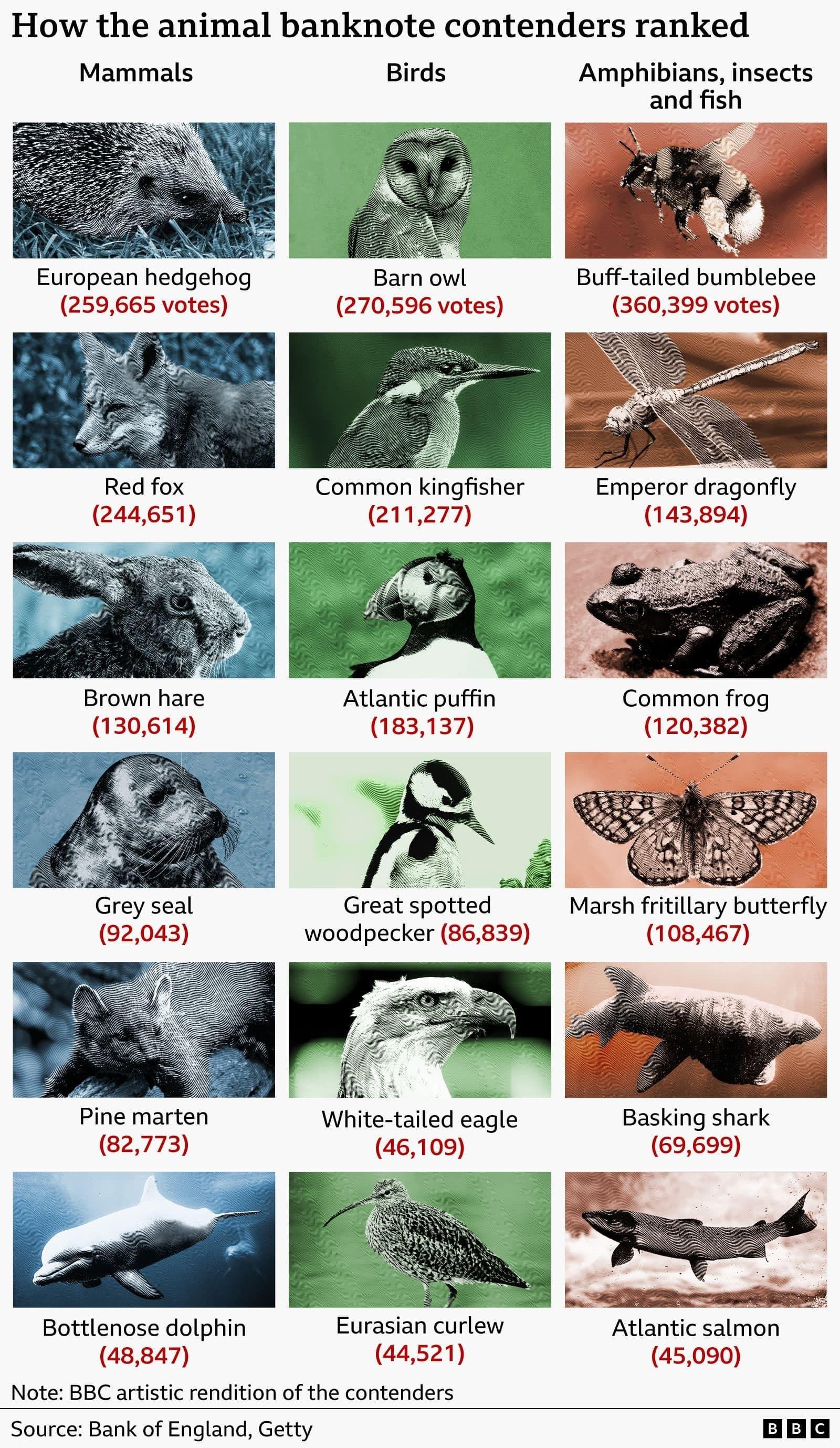
Infographic showing the results of a public vote on animals shortlisted for potential Bank of England banknotes, grouped into three categories: mammals, birds, and amphibians, insects and fish. The buff-tailed bumblebee received the most votes overall with 360,399. Among birds, the barn owl led with 270,596 votes, and among mammals, the European hedgehog ranked first with 259,665. Other highly ranked animals include the red fox (244,651), common kingfisher (211,277), Atlantic puffin (183,137), emperor dragonfly (143,894), brown hare (130,614), common frog (120,382) and marsh fritillary butterfly (108,467). Lower-ranked contenders include the grey seal, pine marten, basking shark, bottlenose dolphin, white-tailed eagle, Atlantic salmon and Eurasian curlew, each receiving fewer than 100,000 votes. The graphic includes illustrated portraits of all 18 animals arranged in ranked order within their categories. Source: Bank of England and Getty.

The Atlantic puffin, barn owl, buff-tailed bumblebee and European hedgehog will represent UK wildlife and feature as the central images on our next series of banknotes.

The decision comes after nearly 500,000 people responded to a public consultation asking which native wildlife they would like to see on our banknotes. They chose from a shortlist of 18 options across three categories – mammals; birds; and amphibians, insects and fish – developed in collaboration with a panel of UK wildlife experts.

The Bank used the feedback from the consultation to decide on the four animals, one for each denomination of banknote. The selected animals meet the Bank’s objectives for a distinctive set of banknotes that can support counterfeit resilience and are representative of the UK.

The barn owl (Tyto alba), buff-tailed bumblebee (Bombus terrestris) and European hedgehog (Erinaceus europaeus) were the most popular animals in their respective categories. The Atlantic puffin (Fratercula arctica) was selected because it was the most popular marine animal. The inclusion of a marine animal will add variety to the series, making the denominations easier to distinguish and will provide an opportunity to celebrate the British coastline.

The decision on which animal will feature on which denomination will be made in due course and announced closer to launch. While the selected animals will feature as the central imagery for the next series, the banknotes will also feature other elements from nature to complete the designs, potentially including other shortlisted animals. The next series will continue to include a portrait of the monarch.

It takes a number of years to design, test and print banknotes, to make sure they are high-quality, resilient and accessible. The expectation is, therefore, that the first denomination from the next series will be launched over the next few years.

Wednesday, 3 June 2026

#588: UK wildlife on British banknotes - the shortlist.

The shortlisted animals which may appear on bank notes from the Bank of England have been revealed.


The replacement of historical characters, particularly Sir Winston Churchill, with British wildlife sent political leaders into a frenzy of condemnation earlier this year.

But now people have a month to offer their views about which species of wildlife should be honoured on the £5, £10, £20 and £50 notes.

The shortlist, chosen by a panel of wildlife experts, excluded household pets. People will be able to vote for up to six of their favourites from the shortlist, external.

The mammals are: the bottlenose dolphin, the brown hare, the European hedgehog, the grey seal, the pine marten and the red fox.

The second category of birds feature: the Atlantic puffin, the barn owl, the common kingfisher, the Eurasian curlew, the great spotted woodpecker, and the white-tailed eagle.

The final section of amphibians, insects and fish, has: the Atlantic salmon, the basking shark, the buff-tailed bumblebee, the common frog, the Emperor dragonfly, and the marsh fritillary butterfly.

Saturday, 14 March 2026

#555: Changing banknotes

I've mentioned some of the wildlife that features on coins and bank notes previously.

Many countries feature wildlife on bank notes as part of the nation's heritage and culture.

Now we may get more wildlife on our bank notes.


Following a consultation. 44,000 people had their say on what themes and images they'd like to see on their notes.

60% of people picked nature as their preferred theme, and so the Bank of England are making a big change.

This suggestion has not gone down well with the Daily Telegraph.


Here's the announcement from the Bank of England.

Wednesday, 24 January 2024

#227: Banking on it

Nan Shepherd appears on the Scottish £5 note. This is one example of Natural History appearing on currency. What other examples can students find?

Here's the story of the design of the banknote. It's been in circulation since 2016. There is a lot of symbology in the image choices for the design.

Nan Shepherd is the author of 'The Living Mountain', about the Cairngorms. It's one of the most influential pieces of nature writing and has influenced othr writers such as Robert MacFarlane.

As well as an image of Shepherd, the RBS £5 note features a quote from the author’s first novel, The Quarry Wood – “It’s a grand thing to get leave to live” – and one from her meditation on the Scottish landscape, The Living Mountain: “But the struggle between frost and the force in running water is not quickly over. The battle fluctuates, and at the point of fluctuation between the motion in water and the immobility of frost, strange and beautiful forms are evolved.”


The reverse of the £5 note features an excerpt from Gaelic poet Sorley MacLean’s poem The Choice, which translates into English as “I walked with my reason, out beside the sea”

The note also features an image of a midge, to “represent the reality of everyday living in the Scottish countryside”, according to RBS. “It’s a reminder that Scottish nature nips us as well as thrills us,” said Macfarlane.

Bonus points too if you can identify the type of fish being shown on the back of the note.

#707: A requiem for Sycamore Gap

Robert MacFarlane has finished work on “The World Tree”, the libretto for a long choral work originally inspired by the felling of the Syca...