Showing posts with label Wildlife. Show all posts

Thursday, 16 July 2026

#621: Wildlife Crime

Wildlife crime is an important issue.

Wildlife crime is any activity that goes against legislation protecting the UK's wild animals and plants. It can cause pain and suffering to animals, push species closer to extinction and can be linked to other serious crimes like firearms offences and organised crime.

Examples include:

  • Hare coursing
  • Using dogs to hunt wild mammals
  • Poisoning of animals, such as birds of prey
  • Disturbing or killing wild birds; or taking their eggs
  • Poaching of game, venison and fish
  • Disturbing, injuring or killing bats, and damaging or obstructing their roosts
  • Smuggling protected species and their parts (such as tortoises, rhino horn, ivory and caviar)
  • Illegally trading in endangered species
  • Taking protected plants from the countryside.

Country Watch Dorset is one of the organisations that is aiming to protect local wildlife from persecution and negative impacts.

#619: Tweet of the Day

This BBC Sounds feature has many episodes.

Each one tends to focus on a species of bird, or something that may connect with birdlife. There is a large range of people who have contributed their voice to a programme, so plenty to catch up here, and they feature some of the species that appear on the lists of birds mentioned in the draft subject content.

Tuesday, 16 June 2026

#594: UK Species

The Natural History Museum has a page on the UK's species.

The museum is working on bringing all of the standard reference names for all species of flora and fauna in the UK, together in one place.

Over 70,000 species of animals, plants, fungi and single-celled organisms are found in the UK.


Tuesday, 26 May 2026

#584: Springwatch 2026

It's always good to have Springwatch back... although that means another spring from the ones that I have left to see...

This time round the team are in Northern Ireland.

Last night's episode was a good opener, and you can see them on BBC and iPlayer. You can keep up with the action on the live wildlife cameras too.


One would hope that someone like Chris Packham or Michaela Strachan might be persuaded to work as ambassadors for the new specification once it gets to the stage where it is introduced into schools.

Thursday, 14 May 2026

#579: Natural History Reading List #26: Fenland Nature

A cross-posting from my GeoLibrary blog, which currently features over 700 books.

This was picked up in Topping Books just before the summer 2025. It's a really detailed and comprehensive guide to the nature to be found in the Fens. It's a book to dip into rather than read cover to cover, with chapters exploring different aspects of the Fenland landscape.

There are lots of excellent photographs, mostly taken by the authors themselves, who have certainly put in the legwork and mileage to cover the region they are writing about.

Publisher's description:

This book showcases the natural history and landscape of the Fens, an area now responsible for a third of Britain’s food production and worth over £3 billion to the economy every year. It describes the geology and geography across the Fenland Basin over the last 14,000 years, a period dominated by the flux of wetlands and movement of water. The human relationship with this landscape is traced through history: from Mesolithic hunters to the prosperity of a medieval economy based on the currency of eels, through the taming and draining of the vast wetlands, to modern farming on an industrial scale.

While recognising that only a fraction of the Fens is left, Fenland Nature celebrates the breadth of wildlife still to be found in the region, from vast flocks of visiting wildfowl in the winter months, to rare and specialised plants and insects – all illustrated with detailed and evocative photographs.

The book concludes by contemplating an uncertain future where there are possibilities for a sustainable agricultural industry alongside increasing biodiversity, requiring new ways of thinking and working with the land. The fenland landscape is a microcosm of the huge global challenges caused by habitat loss, ecological degradation and climate change. If solutions can be found to these complex issues in the Fens, then there is hope that these can also apply to similar places across the world.

It's written by two local authors who really know their local patch well. A great coffee table / browsing book.

A good review by Mark Avery.

It sits nicely with my other Fenland books - dipped into to inform my teaching about the local area.

My copy was published by Pelagic Publishing.

Paperback, 376pp

ISBN: 9781784274108

Friday, 8 May 2026

#576: The path more travelled

 I'm currently reading Nicholas Crane's new book on the history of Britain's footpaths: how they came about originally following the drowning of Doggerland, and were then refined by successive waves of change: horses, the Roman invasion etc. It's a dense and scholarly work, with plenty of points of interest and relevance to geographers exploring the connections between people and the landscape.


He's taking his book on the road in a series of talks, with three confirmed so far. Here's the description for his talk at Stanford's book shop at the end of the month. He's also speaking in Exeter and Stamford.

Walking is a cornerstone of British identity and the most popular form of exercise in the UK. But how much do we know about the paths that we walk? What is their history? Why do they follow the routes that they do? Are they permanent? Can we designate more of them?​

The Path More Travelled is a coast-to-coast history of footpaths from the stone age paths walked by migrants 12,000 years to the industrial revolution and the birth of map and walking apps – from beloved writer and broadcaster Nicholas Crane.​

In The Path More Travelled, acclaimed geographer and writer Nicholas Crane explores this coast-to-coast web that is both ancient and futuristic. Starting with the stone age paths walked by European migrants 12,000 years ago, he traces their development - from early pilgrim paths and coffin tracks, through to the industrial revolution and the birth of the bicycle and car, sat-nav and walking apps. We discover how land-grabbing Norman barons set a precedent for the enclosure of our countryside, and how out of the ashes of World War Two came our beloved national parks. 

Along the way, Crane takes the reader on some of his most memorable walks, including the Hadrian's Wall Path, the outer reaches of the Cairngorms, and the banks of the Severn where he discovers footprints from over 7,000 years ago.​

From one of our most beloved travel writers, The Path More Travelled is a passionate ode to footpaths and a call to rediscover this most fundamental part of our landscape.

Book a ticket here.

#575: Happy Birthday Sir David!

On David Attenborough's 100th birthday.

 
A century of storytelling and curiosity...


Sunday, 12 April 2026

#563: Secret Garden

A new BBC series which started this evening focusses on the wildlife that can be found in people's gardens, although frankly the first episode featured a completely unrealistic garden...

There's an interactive tool as well, made with the Open University, which you can use to uncover the secret wildlife in your own garden.


Saturday, 14 March 2026

#555: Changing banknotes

I've mentioned some of the wildlife that features on coins and bank notes previously.

Many countries feature wildlife on bank notes as part of the nation's heritage and culture.

Now we may get more wildlife on our bank notes.


Following a consultation. 44,000 people had their say on what themes and images they'd like to see on their notes.

60% of people picked nature as their preferred theme, and so the Bank of England are making a big change.

This suggestion has not gone down well with the Daily Telegraph.


Here's the announcement from the Bank of England.

Tuesday, 10 February 2026

#551: World Frog Day - March 20th

One possible additional focus for teachers is to mention or highlight some of the specific days during the year which are linked to specific species of wildlife.

Here's one for you:

March 20th is World Frog Day.

Use the Amphibian Ark website, which has a range of resources.


Thursday, 22 January 2026

#546: RSPB Big Garden Birdwatch

This takes place this coming weekend.

Make sure that you take part in this huge citizen science event. Just give up an hour of your weekend to sit there with a cup of tea and see which birds land in your garden.

At the time of posting around 400 000 people / families have registered to take part.

Come and join us!

Saturday, 10 January 2026

Tuesday, 16 December 2025

#539: Wild London - New Year's Day

Why not welcome 2026 in with the calming tones of Sir David Attenborough.

1st of January, BBC One at 6.30pm - Wild London


Description from the BBC.

After a life spent travelling the globe, the world’s most famous naturalist turns his attention closer to home to explore the wildlife of England’s iconic capital. Having lived in London for 75 years, Sir David has an intimate knowledge of the city’s natural history, and there's no better guide to introduce us to its most spectacular wildlife secrets.

London is considered the greenest major city in the world, with a surprising variety of animal dramas playing out in the most unexpected places. Whether it’s herds of deer invading gardens, pigeons commuting by tube, snakes slithering along Regent's Canal, parakeets raiding green spaces, or seagulls learning new ways to make a killing in the city, Sir David reveals the incredible wild encounters to be experienced across his hometown.

Sir David celebrates the extraordinary ways in which animals are adapting to survive in the urban jungle, whether it be the fortunes of a pair of peregrines nesting on the Houses of Parliament as their chicks attempt their first flight, or a family of foxes living in the heart of Tottenham struggling to get to grips with fierce rivals and dangerous streets. He is inspired as he learns how people across the capital are ensuring some of Britain’s most-loved species can continue to call London home, and he even joins efforts to bring back animals that have disappeared from the city.

Captured over his centennial year, this personal and poignant film is a timely insight into how cities can become homes for wildlife as well as ourselves.

Saturday, 13 December 2025

#538: Barry Lopez - external and internal landscapes

From the classic 'Crossing Open Ground'

“I think of two landscapes- one outside the self, the other within. 


The external landscape is the one we see-not only the line and color of the land and its shading at different times of the day, but also its plants and animals in season, its weather, its geology… If you walk up, say, a dry arroyo in the Sonoran Desert you will feel a mounding and rolling of sand and silt beneath your foot that is distinctive. You will anticipate the crumbling of the sedimentary earth in the arroyo bank as your hand reaches out, and in that tangible evidence you will sense the history of water in the region. Perhaps a black-throated sparrow lands in a paloverde bush… the smell of the creosote bush….all elements of the land, and what I mean by “the landscape.”

The second landscape I think of is an interior one, a kind of projection within a person of a part of the exterior landscape. Relationships in the exterior landscape include those that are named and discernible, such as the nitrogen cycle, or a vertical sequence of Ordovician limestone, and others that are uncodified or ineffable, such as winter light falling on a particular kind of granite, or the effect of humidity on the frequency of a blackpoll warbler’s burst of song….the shape and character of these relationships in a person’s thinking, I believe, are deeply influenced by where on this earth one goes, what one touches, the patterns one observes in nature- the intricate history of one’s life in the land, even a life in the city, where wind, the chirp of birds, the line of a falling leaf, are known. These thoughts are arranged, further, according to the thread of one’s moral, intellectual, and spiritual development. The interior landscape responds to the character and subtlety of an exterior landscape; the shape of the individual mind is affected by land as it is by genes."

I have this same edition.

Monday, 13 October 2025

#508: An island as old as me

Surtsey is a volcanic island which emerged from the sea in November 1963 off the southern coast of Iceland. I have mentioned it previously on the blog as it is a large natural laboratory.

This piece in the Guardian talks about its importance as a place which has been protected from human interference for over 60 years.


In 1965, Surtsey was placed under formal protection by the government. Only researchers and the odd journalist – under strict supervision – would be allowed to visit. No sheep would ever be allowed to graze there. 

It offers hope and practical lessons for rehabilitating ecosystems damaged by war, pollution or exploitation: if space is given, nature will always find ways to return, often faster and more creatively than we expect.

#507: Hamza's Wild Isles

I enjoyed this last night and have enjoyed the other programmes.

A good introduction to some of the wildlife to be found in Britain.

I've seen many of these myself, including badgers in the Peak District, and grebe courtships, and even a Bittern at Titchwell reserve. Also heard them booming on the Broads. Interestingly I was next to the wetlands in Cardiff over the summer as well.

Hamza has had an interesting life.

You can also request a free booklet and postcards from the Open University.

My copies have arrived.


Thursday, 9 October 2025

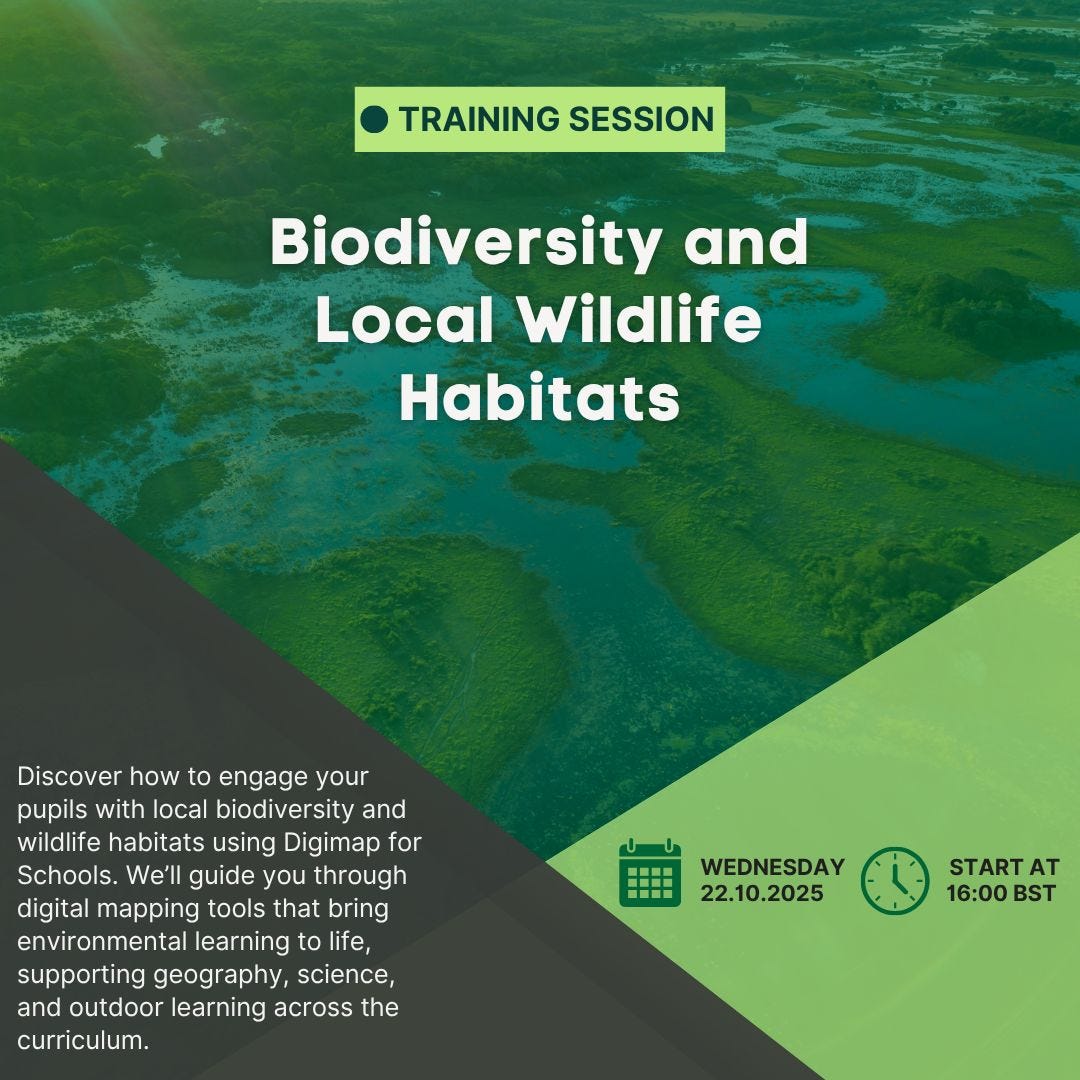
#502: Digimap CPD on mapping local wildlife and biodiversity

A free Digimap for Schools Webinar to help you explore biodiversity and local wildlife habitats. 

This sort of CPD will be valuable for those who have aspirations to teach the new specification.

No alternative text description for this image

Sign up here - it’s free.

Wednesday, 13 August 2025

#485: Some good news...

Via The Guardian today.

News of some recovery in some wildlife populations was shared today by Natural England. 

As part of its £13m species recovery programme’s capital grants scheme, the recovery of 150 species has been supported.


As Tony Juniper says, such nature recovery work needs more projects, more volunteers and more money to flow from all sources, particularly the private sector. It will also need to go hand in hand with improved environmental quality, including through reduced pollution.

Wednesday, 9 July 2025

#463: Wildling App - launches today


The OCR blog has a post from Ant Rawlins.

He talks about the new Wildling app which launches today.

Wildling officially launches nationwide on 9 July, backed by some of the UK’s leading conservation organisations and individuals, including the RSPB, the Marine Conservation Society, Forestry England, and advisors such as Deborah Meaden, Ben Goldsmith, and Sir Tim Smit.

It’s a free app designed to make finding and enjoying nature simpler for everyone. Whether you’re in a city, suburb, or rural area, Wildling helps users discover local nature, explore ideas for getting outdoors, and find calming, inspiring content that can develop confidence and connection with the natural world.

It’s suitable for families, first-timers, educators, and anyone looking to reconnect with nature, and feel better for doing so.

You can download the Wildling app for free from our website.

Wildling has been designed to make it easier for people to engage with the natural world, and that has clear value across many areas of education.

By helping students explore nature where they live, the app can support learning across a wide range of subjects. It’s not about replacing lessons, but enhancing them with real-world experience.


This joins apps such as Melissa Harrison's Encounter app in providing people with a chance to identify and record their encounters with nature, which will be useful for geography as well as for the GCSE Natural History when and if it finally gains approval to be added as a new qualification option.

Thanks to Kerry Sage for the tipoff to the blog post and app.


Sunday, 12 January 2025

#424: A year of Environmental Lunacy

The NAEE is sharing a Year of Environmental Lunacy. 

There will be a monthly post looking at the full moon which occurs in that year. These have a name which often stems from America and Canada's Indigenous / first nation people, and the world they lived in, but that means they are not always appropriate for the UK.

This project is about suggesting a name which fits with the UK's wildlife.

The first one has just gone up, with Paula Owens suggesting that we call the Wolf Moon (January's full moon - which occurs tomorrow) as the Fox Moon.

Delighted to say that I will be contributing one of the monthly posts later in the year.

Check back each month to see a different author suggest an alternative new name for that month's full moon.

#643: The Path More Travelled

A cross posting from my Geo Library blog project - what do you mean you haven't visited? There's over 700 books that would be of in...