Showing posts with label Book. Show all posts

Saturday, 26 April 2025

#445: National History Reading List #23: 'Oak and Ash and Thorn'

Another book that would be good to add to the developing reading list of books for those who are developing curriculum resources for the new GCSE Natural History.

It is a book about the ancient woodlands, as well as the more recent forests of Britain. 

It is written by Peter Fiennes, and focusses on some of the species that have been around for the longest. It would sit nicely with some of the other tree related books I have mentioned before on the blog.

There are plenty of possible locations for field visits here too - and I hope that young people explore woodlands as part of their teaching.

The image shows a useful chapter on the importance of trees in cities. Regular readers will know of the the vital part that trees play in ensuring lower temperatures, and the link with the London National Park City campaign.


Sunday, 29 September 2024

#372: Natural History Reading List #20: 'Orbital'

Updated November 2024


A cross-posting from my GeoLibrary blog which has hundreds of books recommended and with some information about where they might be used, and why they deserve a shelf on the GeoLibrary.

This book is on the Booker longlist. It's a fiction book, but is packed with geography.

It's about four astronauts and two cosmonauts in the International Space Station.

The author said of the book that she wanted to write a 'space pastoral'

The book follows one day, and the orbits they trace over the world. In between their routine jobs and exercise, we hear about them and their families and their thoughts as they stare down on the earth below - tracking the path of a super-typhoon with their privileged view of the world below.

There are some truly wonderful passages, and it's definitely a geography book.

The descriptions of each landscape and country as they appear are really beautiful.

The section here is part of a chapter - they are all very short and this helps you subdivide the book if you want to prolong the reading of it and savour each page - which looks at the point where the astronauts and cosmonauts realise that they can see the hand of people everywhere on the planet which is described as "a landscape of want" - something I've talked about before.

It also links with another story I've told many times before: Bill Anders, 'Earthrise' and the impact of the experience of being in space on those who have to literally come back down to Earth.

I've just finished it and it comes very highly recommended.

Read an extract here.

My copy was published by Vintage and purchased from Topping Books in Ely - support your local independent bookshops!

Paperback, 144pp

ISBN: 978-1529922936


UPDATE
Congratulations to Samantha Harvey. This book was announced on the 12th of November as the winner of the Booker Prize 2024. There has been a lot of press coverage as a result and hopefully plenty of sales.

Thursday, 2 May 2024

#298: 'Homecoming'- out in November '24

One useful practice for those wanting to engage with nature is to keep a journal. I'm not a fan of the verb 'to journal', but 'journalling' as an activity is akin to the scrap books I used to create, or the diaries I used to write capturing what I had for tea and other valuable information to the Mass Observation project.

Melissa Harrison, who has written a number of books which have been mentioned here on this blog has been busy putting together a resource which sounds like it might be of value to explore with young people. 

It is a diary and almanac combined.

Description:

A year-long course in noticing designed to plug you back into the rhythm of the seasons.

Begin in any month and continue round to the start.

Follow the stories, small and large, unfolding all around you - whether you live in the heart of a city or deepest countryside.

Connect to nature, boost your wellbeing and find your way in the living world.

Establish your own rituals, high points and habits to carry you through the year.

Homecoming includes a monthly bird-by-ear as well as rewarding and inspiring activities from meteor spotting to marking each equinox, citizen science to caring for your nearby wild.

Monday, 8 April 2024

#281: Natural History Reading List #17: 'Irreplaceable'

'Irreplaceable' is a book by Julian Hoffman.

It is subtitled 'The Fight to Save our Wild Places' and focusses on a number of locations which are threatened with being lost.

 It has a useful section on ancient woodlands which outlines very clearly what that term means, and the distinction between that and the wildwood.

Each section is relevant to particular types of ecosystems, and the book explores the nature of the threats they face, and the efforts being made to protect them. By the time I read through it, there were lots of post it notes for potentially useful sections.

A very good book as an introduction to the idea of wilderness, and the relationship between humans and nature.

He touches on the plastic threat when he visits the beach in the chapter entitled 'A world within water'.

He describes the discovery of the plastic nurdles which make up a part of any handful of beach sand in most of the world.

"For all its unquestionable usefulness for the human race, a convenience that's turned out to be irressistible to us, plastic places an unearthly burden on the rest of the living world."

My copy was loaned from Norwich Library service.

Saturday, 23 December 2023

#201: Spotify Audiobooks

A cross posting from my GeoLibrary blog which has just reached its 600th post.

I have a Spotify Premium subscription, and have had for quite a few years now.

They have recently added thousands of audiobooks to the subscription, which is great news...

Many of these are of interest to Geographers and an equal number almost also connect with the themes which are likely to emerge in the GCSE Natural History.

Here's a sample that I just located from a few quick searches.

They include Brian Groom's Northerners, which I'm reading at the moment. 

This is likely to reduce my book purchasing and will also be an issue for Audible.


I'm really looking forward to listening to the Tristan Gooley book: 'How to read a Tree'. This will be of particular value for the section on woodlands and trees. I have a feeling that trees are going to be an important feature of the work that is completed by students, and as a destination for fieldwork.


There is a range of books from David Attenborough and George Monbiot.


I have also blogged elsewhere about how fantastic this book by Robin Wall Kimmerer is. Gathering Moss is excellent!

I shall aim to make a list of books for reference.

Friday, 24 November 2023

#188: Fred Ingrams' Flat Earth

One of my favourite contemporary landscape artists is Fred Ingrams.

He has painted hundreds of colourful representations of The Fens over the years, and others of the Flowlands of Scotland, around Caithness.

The Fens is an area that I will certainly look to write about for any resources that emerge, as an example of a landscape with a particular natural history, which has been shaped in recent centuries by the actions of people.

He has now created a book called Flat Earth. Fred says:

I have been painting the Fens for over a decade, producing around 500 paintings in that period. In some ways I suppose this book can be considered a retrospective. 

I’ve chosen a collection of paintings that I feel have passed the test of time – a showreel of my greatest hits. They do not appear in any particular order and are not chronological. It is my hope that looking at this book feels like wandering through an exhibition of my work.

The hard back book measures 23 x 29cm and is 200 pages long, containing over 100 paintings as well as a foreword by Susan Owens and an introduction written by myself.

I have a copy of a catalogue of a previous exhibition of his paintings which has an excellent introduction by Jonathan Meades. 
A film of Fred at work:

Sunday, 22 October 2023

#138: Dorling Kindersley's book of all things Natural History

This is a weighty and impressive looking tome from Dorling Kindersley, who always do such a good job of these types of book.

It looks like an essential part of a Natural History library.


Description from the publisher:

A beautiful guide to Earth's wildlife and natural history, including its rocks, minerals, animals, plants, fungi, microorganisms and more!

Already featuring galleries of more than 5,000 species, The Natural History Book has since been updated to include dynamic discoveries such as the olinguito (the "kitty bear" of the Andean cloud forest), and a new species of deep-sea Bolosoma glass sponge photographed by the NOAA Ship Okeanos Explorer, alongside a reorganization of the groups of living things to reflect the latest scientific understanding.

- A full-colour gallery of over 5,000 species
- Over 500 rocks, minerals and fossils featured throughout
- Includes glossary of important natural history terms
- Specially-commissioned photographs showcase wildlife in close-up detail

This treasure-trove of natural history is accompanied with easy-to-read, accessible information and beautifully-striking imagery, making it a riveting reference guide to pass down for generations to come. The only book to offer a complete visual survey of all kingdoms of life, this nature book for adults is the perfect addition to every family bookshelf, as well as an ideal gift for the nature, animal and plant lover in your life! Gardeners, hikers, and visitors to wildlife park and natural history museums alike would also love this niche nature book, which also doubles up as the perfect coffee table book.

Split into 6 core chapters, covering Living Earth, Minerals, Rocks and Fossils, Microscopic Life, Plants, Fungi, and Animals - there truly is something for everyone to explore, love and learn. From granites to grape vines, from microbes to mammals, The Natural History Book is the ultimate celebration of the diversity of the natural world.

Sunday, 15 October 2023

#126: Natural History Reading List #10: W.G. Hoskins and 'The Making of the English Landscape'

In his pioneering work The Making of the English Landscape (1955), William George Hoskins (1908-1992) claimed ‘to those who know how to read it aright, the English landscape is the richest historical document we possess’. 

William Hoskins (1908-1992) was born in Exeter, Devon, the son of a baker. He won a scholarship to St Hele’s School and later studied at the University of Exeter. In 1931 he became a lecturer at the University of Leicester, where he founded the Department of English Local History in 1948, which went on to pioneer the study of people in their landscapes. In 1951 he was appointed as Reader in Economic History at Oxford University. He was made a fellow of the British Academy in 1969 and became a CBE in 1971. He wrote and edited many books including The Midland Peasant, Local History in England and Two Thousand Years in Exeter. In 1972 he made a television series for the BBC, based on his best-seller, The Making of the English Landscape. He was also president of the Dartmoor Preservation Association and was elected onto the City Council, to help preserve its historic fabric.

The book demonstrated the profound impact of human activity on the evolution of both rural and urban English Landscapes, introducing a brand-new source of primary information for scholars of various disciplines. 

Over the subsequent decades, Hoskins’ work has had profound impact on the work of historians, geographers, archaeologists, planners and conservationists, transforming their approaches to local, regional and national studies.

My version is the Little Toller Books version with cover photography by Fay Godwin.
This is one of the books that will be in my GCSE Natural History library which is taking shape nicely.

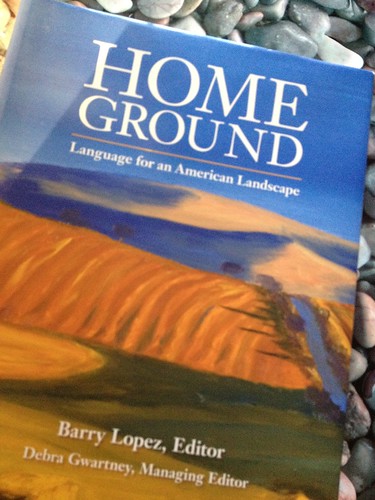
#125: Natural History Reading List #9: 'Home Ground'

Home Ground has an American focus, but would provide a rather fine basis for producing an illustrated glossary of UK specific Natural History terms in the same vein.

I am sure that many of the terms are also relevant to the UK's diverse landscapes.

The book was compiled and edited by the late great Barry Lopez and his partner Debra Gwartney.

Around 100 pages of the book can be read on Google Books here.

The book has definitions of landscape terms - some of which will perhaps be unfamiliar to non-geographers, and not all of which can be found in the UK.

This is a rather wonderful book.
It is a 'dictionary' of features which make up the landscape of the United States.

Many of the landscape terms are illustrated and accompanied by short essays from a range of contributors along with quotes. This is much better than the typical A-Z because of the eclectic nature of the articles and essays and the quality of the writing and illustrations.

Published in America, but available from Amazon.

My copy was published by Trinity University Press in 2006
Hardback, 450pp
ISBN: 1 - 59534 - 024 - 6

Contributors include: Jeffery Renard Allen, Kim Barnes, Conger Beasley, Jr., Franklin Burroughs, Lan Samantha Chang, Michael Collier, Elizabeth Cox, John Daniel, Jan DeBlieu, William deBuys, Gretel Ehrlich, Charles Frazier, Pamela Frierson, Patricia Hampl, Robert Hass, Emily Hiestand, Linda Hogan, Stephen Graham Jones, John Keeble, Barbara Kingsolver, William Kittredge, Jon Krakauer, Gretchen Legler, Arturo Longoria, Bill McKibben, Ellen Meloy, Robert Morgan, Susan Brind Morrow, Antonya Nelson, Robert Michael Pyle, Pattiann Rogers, Scott Russell Sanders, Eva Saulitis, Donna Seaman, Carolyn Servid, Kim Stafford, Mary Swander, Arthur Sze, Mike Tidwell, Luis Alberto Urrea, Luis Verano, D. J. Waldie, Joy Williams, Terry Tempest Williams, and Larry Woiwode.

Wednesday, 27 September 2023

#105: Natural History Reading List #8: Land Healer: How farming can save Britain's countryside

Relatively new in my library is the paperback version of a book by Jake Fiennes, who is currently Head of Conservation on the 25000 acre Holkham Estate in North Norfolk.

This article in The Guardian says a little more about Jake and his work.

It describes the work that has been carried out at Holkham, and the earlier work that taught Fiennes the methods that he is now using. I used to be a regular visitor to the Holkham Estate when a relative owned a caravan which was located there, but he sadly sold out.

This previous article from December 2021 explores some of his conservation work on the coastal marshes on the Holkham Estate.

He has also been profiled in 'The New Yorker'. Limited viewing possible.

The book explores some of the projects that Jake has instigated, and makes suggestions for how farming can make a difference in a positive way. It provides a hopeful message for the way that farming could be - sadly the Government and those in charge of the crucial departments aren't listening to the right people it seems.

Friday, 28 July 2023

#61: Valuing Nature from the RGS-IBG

A new resource from the RGS for July 2023.

Description:

Valuing Nature promotes exactly that, a renewed awareness that we must value the natural world. The book, written by Dr Rob Fish, addresses the growing schism between humans and nature, and encourages us to remember we are one of many elements in ‘the web of life’. Illustrated by Holly McKelvey, the story begins on the fictitious campus of Ostrom University and – through the characters of Aisha, Michael, Sebastian, Chloe, Simone, and Joseph – touches upon the definition of nature and the different approaches we have to it.

The interaction between people and nature is dynamic. It is an ‘assemblage of human and non-human life forms’. Ultimately, it is important to understand that the natural systems of planet Earth make varied and valuable contributions to human wellbeing, and we must cherish and protect them. This is a sustainability concept known as ‘the Ecosystem Services Framework’.

#643: The Path More Travelled

A cross posting from my Geo Library blog project - what do you mean you haven't visited? There's over 700 books that would be of in...