Showing posts with label Humans and Nature. Show all posts

Saturday, 8 August 2026

#643: The Path More Travelled

A cross posting from my Geo Library blog project - what do you mean you haven't visited? There's over 700 books that would be of interest to geographers.

'Absorbing and exhilarating . . . This book will literally expand your horizons' MICHAEL PALIN
'A panoptic, deeply researched and compelling history of our nation' PATRICK BARKHAM

This was the book I finished at the beginning of the summer break.

It's a chunky tome from Nicholas Crane which sits alongside his earlier book on the making of the landscape of Britain.

It explores the origin of the paths and tracks that run through England, from their first makings as the landscape was populated with the first arrivals. 

The paths firmed up with foot traffic and created a network of paths connecting settlements as they developed. Horses expanded the network, and trade turned them into roads. They were joined by trains and canals and then the car changed everything.

It's scholarly and accessible and full of incident and detail, taking you through the thickets of ancient woodland and out to the development of motorways and the current issues we face travelling through the countryside, including past struggles to gain access to open access land.

Details from the publisher:


In The Path More Travelled, acclaimed geographer and travel writer Nicholas Crane explores the hidden history of Britain's coast-to-coast web of footpaths, from the icy Cairngorms to the banks of the Severn (where he discovers footprints left over 7,000 years ago). 

Witty, wide-ranging and passionate, this is an enchanting call to rediscover and protect the lifeblood of our landscapes.

My copy was published by W&N in 2026

Hardback, 432pp

ISBN:  978-1399605816


If you want to hear more about the book, Nicholas Crane is doing a series of events around the country, including a talk in King's Lynn at the Town Hall.

Your best option if you live in the East of England is to come along to our Christmas social event on Tuesday the 8th of December.

It will be hosted by Norwich School.

Nick will have a focus on the ancient footpaths of East Anglia as well, given the location of the talk, and the fact he was born in Cringleford - a few miles from where my daughter lives - and grew up in the area.

My ticket is booked, so I will see you there and may even help you get some sausage rolls and brownies once the talk is over. We usually have mulled wine on arrival as well...

Thursday, 16 July 2026

#620: Prairie - Candace Savage

This looks like being particularly good. I'm really keen on books like this which promise to tell the human history of physical / natural regions / biomes.

I will look to get this out of the library and add it to the blog once I've had the chance to read it.

Saturday, 4 July 2026

#609: Traffic noise and baby birds...

We know that traffic noise causes harm to human health.

It increases stress levels, and the associated air pollution affects air quality.

This piece from April 2024 explains how it also damages nature and forces birds to sing louder.

Noise from traffic stunts the growth of baby birds.

Image: Alan Parkinson, shared on Flickr under CC license

Tuesday, 26 May 2026

#581: Natural History Reading List:#27 Entangled Life: How Fungi Make Our Worlds, Change Our Minds and Shape Our Futures

I have this book as an Audible copy, and it is excellent. 

It is also available to purchase in paperback and hardback, or loan from your local library.

If you haven't already got a copy then it may be worth going for the illustrated version which has some wonderful images of fungi.

A film of the book has also been made, with narration by Björk.


Thursday, 30 April 2026

#569: Jane Goodall - someone to mention

We recently lost a real hero of Natural History: Dr. Jane Goodall.

She had spent her life speaking about the need to conserve nature, and habitats, particularly for primates. 

There are many quotes which are attributed to her, where she shows the true value of connecting with nature.

She also recorded a Netflix special interview for "Famous Last Words" which she said could only be shown after her passing and in this she named the people she thought were having the greatest impact on the natural world through the actions of their companies or political decisions. 

Who would be on your list of people to mention as part of a GCSE Natural History specification??

Let me know in the comments.

Saturday, 22 November 2025

#526: John Clare and an Inherited Perspective

Another name which I hope the new specification introduces young people to is the poet John Clare.

He is the subject of a book by the London-based writer and psychogeographer Iain Sinclair, who traced his footsteps. The cover of the book can be seen below. It is called 'Edge of the Orison'.

https://www.poetryfoundation.org/poets/john-clare

Click the link to download the whole eBook - thanks to Nottingham Trent University. (PDF download)

Image via Wikipedia - Public Domain


#524: Man

By Steve Cutts - made in 2012, but only just came across it... looks at our relationship with the natural world - dark humour, so don't watch if you're particularly sensitive.

Monday, 17 November 2025

#521: National Tree Week 2025

The resource pack from the Tree Council for this year's National Tree Week has been made available as a PDF download via this link.

The week itself runs from the 22nd to the 30th of November.

By the way, for an excellent book on British woodlands check out 'British Woodland' by Ray Mears. A lovely book! It's in my library...

Sunday, 12 October 2025

#506: Nature connectedness

This two word phrase is likely to become increasingly important to many taking the new specification I would imagine. I would be surprised if an increase in this was not added as an outcome from studying GCSE Natural History.

Nature connectedness is intended to replace the current disconnect between young people and the natural world flagged up by a number of writers, including Robert MacFarlane.

How can this be fostered in young people?

Perhaps time spent outside?

A recent BBC News article suggested as little as 20 minutes is enough to have an impact.

Ideas welcome. How best to do this?

Image: Alan Parkinson, shared on Flickr under CC license

Tuesday, 7 October 2025

#501: Green to Grey

Green to Grey tracks environmental change in the EU.


Here's the opening shots of the website which includes a wealth of information and imagery on environmental change. Would go well with Daniel Raven Ellison's 100 Seconds films.

The website has many stories and details of specific locations.
It was featured in this recent Guardian piece outlining the rate of change of the environment. We often talk about deforestation in the Amazon, forgetting that we are degrading the landscape here in Europe, and even more so in the nature-depleted UK.

Thanks to Alice Griffiths for the tipoff here.

Monday, 11 August 2025

#484: Nature connectedness

A recent piece in The Guardian by Patrick Barkham on some work by Miles Richardson on nature connectedness.


Nature connectedness is bad in Britain.

"We are seeing an ongoing “extinction of experience” with future generations continuing to lose an awareness of nature because it is not present in increasingly built-up neighbourhoods, while parents no longer pass on an “orientation” towards the natural world. Other studies have found parental nature connectedness is the strongest predictor of whether a child will become close to nature.

“Nature connectedness is now accepted as a key root cause of the environmental crisis,” said Richardson. “It’s vitally important for our own mental health as well. It unites people and nature’s wellbeing. There’s a need for transformational change if we’re going to change society’s relationship with nature.”

A newborn child is much the same as a child born in 1800. Children are fascinated by the natural world. It’s maintaining that through their childhood and schooling that’s essential, alongside urban greening. There’s policies starting to do that but we’ve got to think in transformational terms – not 30% but 1,000%.”

One particular statistic from the report was shocking...

A study found that people in Sheffield on average spent just four minutes and 36 seconds in natural spaces each day.

Friday, 11 April 2025

#442: "Freakosystems"

A piece on the BBC Futures website talks about the impact of people on a Hawaiian island which has produced a very unusual ecosystem.


O'ahu's lowland forests are now almost entirely devoid of the plants and animals that grew here for millions of years before the arrival of humans. Settlers brought extinctions by cutting down trees to make farms and introducing voracious predators and disease-carrying animals. Today, these tropical forests are a tapestry of non-native species introduced from every corner of the planet: Brazilian peppertree, Indonesian cinnamon and roseleaf bramble from the Himalayas and Australia. Most of the animals, including all the birds that Tarwater mentioned earlier, are also alien.

Update
Another example....

Thursday, 28 November 2024

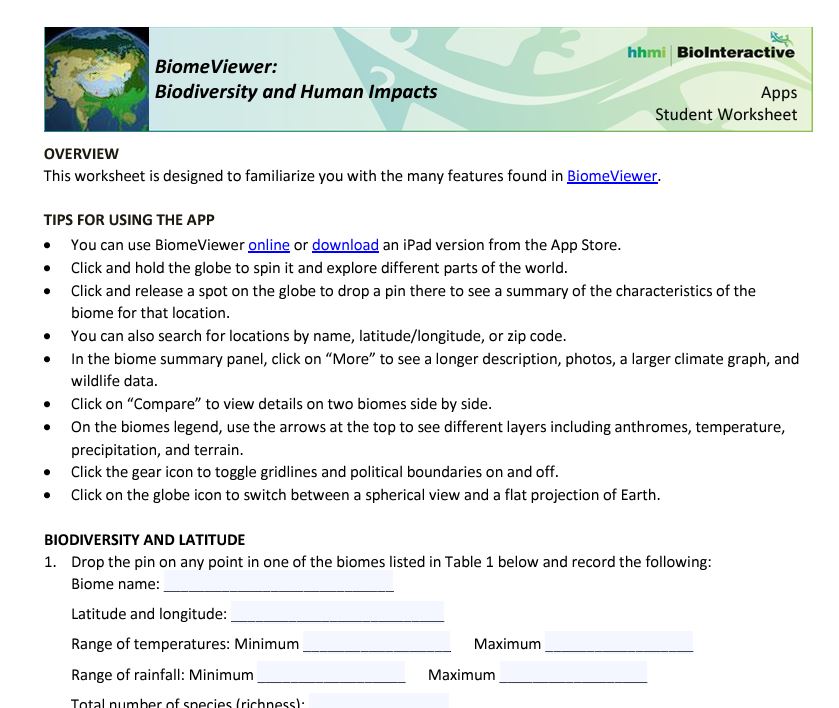
#405: Biome viewer

Thanks to Hannah Steel for the link to this useful visualisation tool.

Biomeviewer displays a range of information in a visual way.

It's really useful for identifying biomes in a general way, and rotating the globe to see where they are located and identifying their characteristics.

There are accompanying resources in a folder, student worksheet and apparently an iOS app too.

The worksheet takes students through the various features which are built into the app.


You can also explore anthromes: anthropogenic biomes. These are where the majority of humanity lives.

A classification proposed by E.C. Ellis, October 25, 2005 lists them. Minimum mapping scale greater than or equal to one square kilometer.


There is a lot more information and some useful maps on this website too, which is the new home of the previous link. Lovely work and I now want to do something with this as well...

Tuesday, 29 October 2024

#389: Humans and nature

The phrase 'more than human' is one I hadn't heard until a few years ago, when I attended a session run by Sharon Witt and Helen Clarke.

More than Human Rights is an interesting concept.

Check out their work here. 


Monday, 28 October 2024

#388: Riversong

Riversong is here, and free for anyone to use.


Sunday, 29 September 2024

#374: 'The Story of Nature' - new in

A new arrival this month was this chunky new book by Jeremy Mynott which promises to explore the story of mankind's changing relationship with nature.


This would seem to offer a scholarly perspective on many of the original ideas that underpinned the draft specification, and which I hope end up being in the final version.
I have made a start and am mightily impressed so far.
It has made me reconsider the reasons why cave paintings were made, and the way that domesticating animals changed our relationship with certain animals.

If you want a taste of the book, you can visit Amazon, where you can look inside the book.
I am looking forward to continuing the story over the coming months.

This comes highly recommended. A full review will come once I've finished it...

#372: Natural History Reading List #20: 'Orbital'

Updated November 2024


A cross-posting from my GeoLibrary blog which has hundreds of books recommended and with some information about where they might be used, and why they deserve a shelf on the GeoLibrary.

This book is on the Booker longlist. It's a fiction book, but is packed with geography.

It's about four astronauts and two cosmonauts in the International Space Station.

The author said of the book that she wanted to write a 'space pastoral'

The book follows one day, and the orbits they trace over the world. In between their routine jobs and exercise, we hear about them and their families and their thoughts as they stare down on the earth below - tracking the path of a super-typhoon with their privileged view of the world below.

There are some truly wonderful passages, and it's definitely a geography book.

The descriptions of each landscape and country as they appear are really beautiful.

The section here is part of a chapter - they are all very short and this helps you subdivide the book if you want to prolong the reading of it and savour each page - which looks at the point where the astronauts and cosmonauts realise that they can see the hand of people everywhere on the planet which is described as "a landscape of want" - something I've talked about before.

It also links with another story I've told many times before: Bill Anders, 'Earthrise' and the impact of the experience of being in space on those who have to literally come back down to Earth.

I've just finished it and it comes very highly recommended.

Read an extract here.

My copy was published by Vintage and purchased from Topping Books in Ely - support your local independent bookshops!

Paperback, 144pp

ISBN: 978-1529922936


UPDATE
Congratulations to Samantha Harvey. This book was announced on the 12th of November as the winner of the Booker Prize 2024. There has been a lot of press coverage as a result and hopefully plenty of sales.

Saturday, 7 September 2024

#361: Natural History Poems #1 - Hallaig by Sorley MacLean

The first of a series of posts suggesting poems that students could be asked to engage with

Hallaig is a poem by the late Gaelic poet Sorley MacLean or more correctly Somhairle MacGill-Eain.

You can find out more about his life at this website, which has been around for a long time. He has a long career and was influential on the Isle of Skye and beyond.

I had the great pleasure of meeting him briefly while walking through the village where he lived, and close to which a friend was living at the time.

The poem was set to music by the late musician Martyn Bennett (one of my favourite musicians).

Saturday, 24 August 2024

#360: A fishy tale

A cross-posting from my Passed the Point of No Return blog.

Back in 1983-4 I had a lecturer on my undergraduate degree course from a wonderful lecturer called Alan Pitkethly. He is fondly remembered by many of his students. 

He would lecture without notes often, sat on the desk, taking us along on a story. One of his lectures was on the idea of the 'Commons' and the changing fortunes of salmon in Canadian rivers.


This Guardian article looks at the decline in migratory fish populations and the impact of human activity.

#643: The Path More Travelled

A cross posting from my Geo Library blog project - what do you mean you haven't visited? There's over 700 books that would be of in...