Showing posts with label Landscape. Show all posts

Saturday, 18 July 2026

#626: Octavia Hill

Another person on the list of people who students studying the course should be introduced to is Octavia Hill.

Octavia Hill tried to improve access to nature for the people of the UK. In doing so, she was one of three founders of the National Trust.


Image copyright: National Trust.

Founding the charity in 1895, she said she believed that “the healthy gift of air and the joy of plants and flowers” were vital in everyone’s life.

The National Trust wants city dwellers to be given more access to nature.

Monday, 11 May 2026

#577: Natural History Reading List #25: 'How to read a Tree'

Another really useful book by navigation expert Tristan Gooley.

I have a signed copy of his previous book: 'The Natural Explorer'

This book explores what a tree can tell us about the landscape. It says a great deal about the value of trees and how they interact with the soil, atmosphere, weather and biodiversity. They influence the drainage and fertility of the soil, and can also tell us a lot about where we are, and how the landscape is changing.

The loss of a tree can touch millions, as we saw with the felling of the Sycamore Gap tree.

It would make a useful book to add to the library for those who are considering work in local woodlands for fieldwork. We are still waiting to see to what extent woodlands are featured in the final specification.

My thinking would be that the final specification would involve students investigating a range of ecosystems and the value of a tree is something which students should certainly be asked to consider, perhaps when thinking about the wider 'value' of nature in our lives and landscapes.

Published by Hodder Press

Paperback, 320pp

ISBN: 978-1529339628

Monday, 16 February 2026

#552: The John Clare Countryside Project

This was on the local news magazine programme tonight.

John Clare was a poet who was influenced by nature and the outside world.

The artist in residence Kathryn Parsons was interviewed.

The project is expanding.


An excellent booklet which provides details of the project


The 2015 film By Our Selves (Andrew Kötting), featuring Toby Jones, traced Clare’s walk. Other fans of Clare’s work include Patrick Stewart and Damon Albarn.

Saturday, 22 November 2025

#526: John Clare and an Inherited Perspective

Another name which I hope the new specification introduces young people to is the poet John Clare.

He is the subject of a book by the London-based writer and psychogeographer Iain Sinclair, who traced his footsteps. The cover of the book can be seen below. It is called 'Edge of the Orison'.

https://www.poetryfoundation.org/poets/john-clare

Click the link to download the whole eBook - thanks to Nottingham Trent University. (PDF download)

Image via Wikipedia - Public Domain


Thursday, 24 July 2025

#470: Weathering Collective

An organisation looking at the impact of our lives on the landscape and how it has been represented in art.

Check out their website.

I like how they refer to "the potent fictional constructs we call maps..." - something I discuss with Year 6 students.


Saturday, 26 April 2025

#446: Doggerland

Doggerland is the name given to an area which is now submerged beneath the North Sea. 

The higher sections of the land are known as Dogger Bank: a fishing ground.


The National Geographic has explored the area.

At the end of the last ice age, Britain formed the northwest corner of an icy continent. Warming climate exposed a vast continental shelf for humans to inhabit. Further warming and rising seas gradually flooded low-lying lands. Some 8,200 years ago, a catastrophic release of water from a North American glacial lake and a tsunami from a submarine landslide off Norway inundated whatever remained of Doggerland.

There have been many items dredged up by trawlers from this area, or found on beaches along North Sea coasts. Doggerland was home to Mesolithic peoples.

Origin of the name:
Doggerland was named by University of Exeter archaeologist Bryony Coles in the 1990s after the Dogger Bank, a stretch of seabed in the North Sea in turn named after the 17th century “Dogger” fishing boats that sailed there


The floor of the North Sea is now recognized as the largest well-preserved prehistoric archaeological landscape in the world. It would have been a paradise for the bands of hunter-gatherers who followed the retreating ice sheets into the region to settle there. They, however, were not Doggerland’s first inhabitants. Millennia prior to their arrival, the North Sea basin had belonged to Neanderthals, who lived there for hundreds of thousands of years. During the last Ice Age, between roughly 125,000 and 15,000 years ago, Doggerland was part of the cold and dry mammoth steppe. Because vast quantities of water were trapped in glacial ice sheets, the North Sea was around 450 feet lower than it is today. It was a mostly treeless, grassy plain that attracted mammoths and woolly rhinoceroses as well as herds of reindeer, horses, and aurochs.

This would be a potential case study for the proposed theme on landscape change.

Saturday, 1 March 2025

#433: National Character Areas (NCAs)

Natural England has updated the National Landscape Character assessments on their website.

 Wherever you are in England you are in one of these areas, which has a particular character.


Each NCA represents an area of distinct and recognisable character at the national scale. 
Their boundaries follow natural lines in the landscape, not county or district boundaries. 

This makes them a good framework for decision-making and planning for future change. 

The information contained within the NCA profiles aims to help guide land management and other activities to strengthen character and resilience, responding to pressures such as climate change.


I was born in Area 38: Nottinghamshire, Derbyshire and Yorkshire Coalfield

I studied in Area 37: Yorkshire Southern Pennine Fringe

I trained as a teacher in Area 41: Humber Estuary

My first job was in Area 69: Trent Valley Washlands

The first home I owned was in Area 76: North West Norfolk and my school was on the very edge of Area 46: The Fens

I spent three years working in Area 37 - Yorkshire Southern Pennine Fringe, when I worked for the Geographical Association.

I now live in Area 84: Mid Norfolk, and my current school is in Area 46: The Fens

What numbers have you lived in?

Sunday, 29 December 2024

#417: Natural History Reading List #21: Cairn

The latest book by Kathleen Jamie explores the relationship between man and nature as we age. She is the same age as me pretty much, and has reflected on her life and the breakdown in the natural world that she has observed in that time.

Cairn is the new book by the poet and author Kathleen Jamie. In 2021, she was appointed as Scotland's national poet or Makar.

Cairn is a book where she reflects on turning 60 and the changes that have happened to nature in her life, and the challenges to come from the climate breakdown. It is a book made of fragments and stories - each one comprising a stone of the cairn which is built during a life, and which is hopefully 

From the publisher:

Jamie’s intent noticing of the natural world is suffused with a clear-eyed awareness of all we endanger. She considers the future her children face, while recalling her own childhood, and notes the lost innocence in the way we respond to the dramas of nature. With meticulous care, she marks the point she has reached in life and within the cascading crises of our times.

For me, the most wonderful piece of writing in the book comes towards the end in a short piece called 'Erratic'. This is well worth reading and reflecting on.

My copy was published by Sort of Books in 2024

Paperback, 144pp

ISBN: 978-1914502002


Saturday, 21 December 2024

#412: Birdsong matters... and it's disappearing

A piece in The Guardian from a few days ago talks about the slow disappearance of birdsong from the landscape.

Biodiversity is rapidly declining, reducing the quantity and quality of human interactions with nature and constraining its contribution to human health and well-being. Natural sounds are a key component of our experience of nature, but biodiversity losses are reflected in soundscapes, which are becoming less diverse and quieter.


There are various terms here which may relate to the changing relationship we have with our surroundings. The soundscape is changing, and shifting baseline syndrome means we are not necessarily aware of what we have lost. Landscapes emanate a collection of biological, geophysical and anthropogenic sounds which together form ‘soundscapes’

Check out this academic paper which is mentioned in the piece. It's accessibly written. On the extinction of experience.

Saturday, 12 October 2024

#383: Anticipatory History

A cross-posting from my GeoLibrary blog.

This is a book published by uniformbooks. It explores ideas of localness and sense of place. 

Anticipatory history is the present day really, where we explore our landscapes and bring them to life with stories.

Here's a review from the uniformbooks website.

In brief, various authors have been given free rein to elaborate upon a number of critical terms now at work in debates about landscape, ecology, climate change and futurology, ranging from the technical to the poetical, and from the instrumental to the epiphanic. Thus we get wonderful expositions on what is meant by Adaptation, Dream-maps, Entropy, Liminality, Memory, Rewilding, and Presentism, amongst many others—in fact fifty glossaries in all. The initial brief for this research endeavour was “to explore the roles that history and story-telling play in helping us to apprehend and respond to changing landscapes, and to changes to the wildlife and plant populations they support.” The editors rightly caution themselves and their readers against the dangers of instrumentalising the history-writing process, bending a reading of the past to suit the needs of the present and the future.

Not surprisingly forms of land ownership and its management and stewardship loom large. The short essay on ‘Commons’ rehearses Garrett Hardin’s famous essay on ‘The Tragedy of the Commons’, which suggested that self-interest will always ultimately defeat the social aims of things held in common. However, it doesn’t reprise historian E. P. Thompson’s counter-argument that in particular societies at particular times, a ‘moral economy’ is brought in to play to regulate private behaviour. It was also surprising—though perhaps there wasn’t enough room—that the entry on ‘Rewilding’ focused entirely on vegetative succession with no mention of the fearful ‘Beast of Bodmin Moor’, nor of the proposal to re-introduce sea-eagles to the East Anglian shoreline.

Attention also gravitates towards the newer, more problematic landscapes which now require a fuller understanding of how they might be managed in the future: the ‘edgelands’ or ‘drossscapes’ produced by failed urbanisation or de-industrialisation. Are these settings just as valuable and worth conserving as farmed or so-called natural habitat? What was once called the search for authenticity in human existential terms, now applies to concrete and clay. Here the newer discourses of psycho-geography and psycho-biogeography are proving to be invaluable in summoning meaning and history from even the bleakest terrain (on such matters see the excellent entry, ‘Liminal zone’).

There are no settled positions on any of these matters any more, as the entry on ‘Enclosure’ concludes. Once upon a time open common land was hedged in and parcelled up into private lots, which had very bad social consequences. When, a century or so later, the hedgerows were uprooted in the name of industrialised farming, much of the flora and fauna using them as habitat disappeared. Now we are re-instating hedges again. “Perhaps,” the author of this entry concludes, “we might think of enclosure as an example of the human modification of land that slips from its moorings, and accept that each generation makes the enclosure it needs.”

The book contains words, terms and concepts that are completely new to me, including the book’s suggestive title, ‘Anticipatory History’. I had not heard of Rephotography before, nor ‘Shifting baseline syndrome’ let alone ‘Palliative curation’. ‘Presentism’ I knew, but not how to pronounce it—and still don’t. Yet these elucidations are vital resources in the debates ahead about how we handle the transition from the past into the future, and provide a much-needed contribution to the crucial matter of ‘Inter-generational equity’.
A terrific and thought-provoking book.

Ken Worpole


Wednesday, 18 September 2024

#370: Norman Ackroyd RIP

Art will hopefully keep its place in the draft specification.

I was sorry to hear this evening of the passing of Norman Ackroyd on Monday: one of our very greatest landscape artists.

He was a remarkable printmaker and artist. He shared the laborious process of making his etchings in several documentaries.

Listen to this programme with Robert MacFarlane.

Here's the first part of a documentary on his method featuring some of his art...


Friday, 12 July 2024

#339: Romani gypsies and the landscape

Via Twitter - Historic England

Alternative views on our landscape and history.

Romani Gypsies arrived in the United Kingdom over 500 years ago, leaving an indelible mark on everything from art, music, and film to food, language, and politics. It could be assumed that with a culture historically centred around nomadism, tangible remains of this ethnicity are hard to spot. But the heritage of Romani Gypsies is all around us, seen in street names, old stopping places, at crossroads, cemeteries and meadows. 

In this short film, archaeologist and broadcaster John Henry Phillips explores the Suffolk countryside where he grew up to search for what remains and reflect on whether Romani Gypsy history has been forgotten or overlooked.

John Henry Phillips is an author, archaeologist, and filmmaker. He co-founded the non-profit Romani Community Archaeology, which excavates historic Romani sites alongside present-day Romani communities. John Henry is the author of The Search, presenter of Channel 4’s The Great British Dig, and created PBS’s No Roses On A Sailor’s Grave. 'Searching for Romani Gypsy Heritage' was created and composed by John Henry Phillips.

Monday, 26 February 2024

#248: Skye and The Cuillins

The Isle of Skye is a place which has a special place in my heart after repeated trips there in my 20s and 30s to climb and explore the island with friends.

Simon Ingram's book explores the key mountain range in the south of the island: the Black Cuillin Hills. it is available as a chunky paperback which looks rather fine on a shelf. The majority of the book is more about the geology and sense of place of the hills and their exploration by early climbers.

Chapter 12 is entitled 'Treasure'.


This chapter considers the natural history of the mountain range. It is well worth a listen if you have a chance. 

There's a few cultural references too, which I would try to bring in, including the poetry of Sorley MacLean and the music of the much-missed Martyn Bennett.

Sunday, 18 February 2024

#240: Passport to Natural History

Have you ever looked inside your passport (assuming you have a British one...)?

Thankfully for the next few years at least mine is burgundy and mentions the European Union. 

The passport contains a number of pages with designs which include features of the United Kingdom. My old passport was a special design.

This was introduced in 2010. (PDF download)

The design theme was called ‘Scenic United Kingdom’ and includes images of well-known landscape scenes, including the White Cliffs of Dover, the Gower Peninsula, Ben Nevis and the Giant’s Causeway. 

There are also weather symbols on the pages, familiar from the weather forecast on the BBC.

In 2015, this was changed to a design which included British engineers and inventors who had given the world something important. They are listed in the document here. This is the one I have at the moment.

The more recent passport design is outlined here.

This Dezeen page also outlines some of the security features of the new passport, which appear under UV light.

It shows some of the designs of other country's passports, many of which also include landscapes. I love the Norwegian passport design.


Wednesday, 24 January 2024

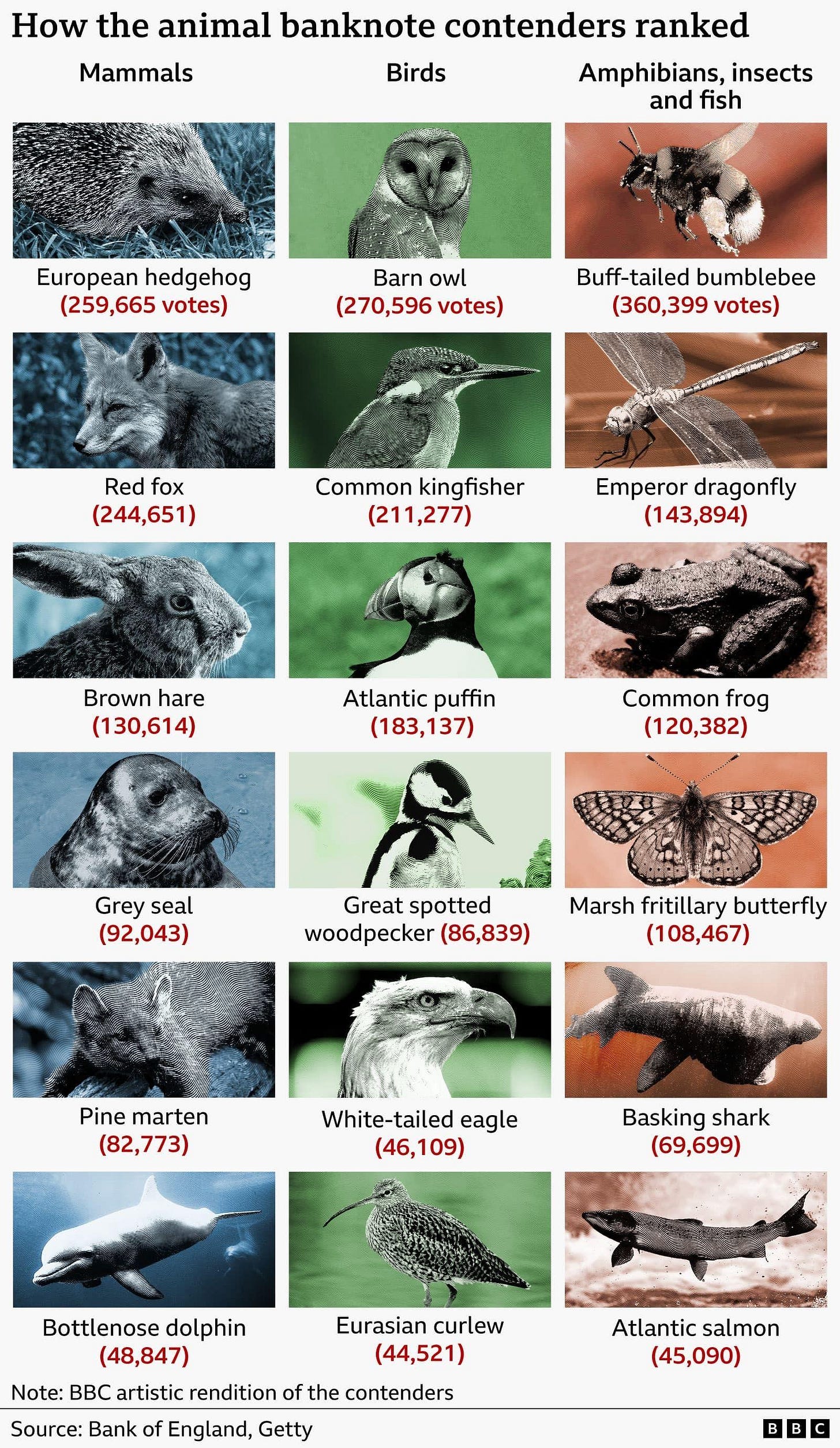
#227: Banking on it

Nan Shepherd appears on the Scottish £5 note. This is one example of Natural History appearing on currency. What other examples can students find?

Here's the story of the design of the banknote. It's been in circulation since 2016. There is a lot of symbology in the image choices for the design.

Nan Shepherd is the author of 'The Living Mountain', about the Cairngorms. It's one of the most influential pieces of nature writing and has influenced othr writers such as Robert MacFarlane.

As well as an image of Shepherd, the RBS £5 note features a quote from the author’s first novel, The Quarry Wood – “It’s a grand thing to get leave to live” – and one from her meditation on the Scottish landscape, The Living Mountain: “But the struggle between frost and the force in running water is not quickly over. The battle fluctuates, and at the point of fluctuation between the motion in water and the immobility of frost, strange and beautiful forms are evolved.”


The reverse of the £5 note features an excerpt from Gaelic poet Sorley MacLean’s poem The Choice, which translates into English as “I walked with my reason, out beside the sea”

The note also features an image of a midge, to “represent the reality of everyday living in the Scottish countryside”, according to RBS. “It’s a reminder that Scottish nature nips us as well as thrills us,” said Macfarlane.

Bonus points too if you can identify the type of fish being shown on the back of the note.

Friday, 24 November 2023

#188: Fred Ingrams' Flat Earth

One of my favourite contemporary landscape artists is Fred Ingrams.

He has painted hundreds of colourful representations of The Fens over the years, and others of the Flowlands of Scotland, around Caithness.

The Fens is an area that I will certainly look to write about for any resources that emerge, as an example of a landscape with a particular natural history, which has been shaped in recent centuries by the actions of people.

He has now created a book called Flat Earth. Fred says:

I have been painting the Fens for over a decade, producing around 500 paintings in that period. In some ways I suppose this book can be considered a retrospective. 

I’ve chosen a collection of paintings that I feel have passed the test of time – a showreel of my greatest hits. They do not appear in any particular order and are not chronological. It is my hope that looking at this book feels like wandering through an exhibition of my work.

The hard back book measures 23 x 29cm and is 200 pages long, containing over 100 paintings as well as a foreword by Susan Owens and an introduction written by myself.

I have a copy of a catalogue of a previous exhibition of his paintings which has an excellent introduction by Jonathan Meades. 
A film of Fred at work:

Saturday, 11 November 2023

#172: Natural History Reading List #13: 'The Making of the British Landscape' - Nicholas Crane

A cross posting from my GeoLibrary blog which has been on the go for over 10 years. The title of this book is a slight extension of the W.G. Hoskins classic 'The Making of the English Landscape'. 

The book is written by geographer Nicholas Crane who has previously been involved in series such as 'Coast' and 'Map Man'.

There is also a book of the same name by the archaeologist and historian Francis Pryor.

My copy is a signed copy from Topping Books in Ely - a recommended stopping off point if you are in the fine city of Ely.

The book takes a chronological view of the British Isles going back ten thousand+ years to the end of the Ice Age, whem we were still connected to Europe, before sea levels rose and Doggerland was drowned. 

Chapters explore a range of different time periods, set across three 'books' and six discrete sections of the book.

The first section covers the period from 10 000 - 4050 BC - from the Ice Age to the separation of the UK from Europe.

There are looks at fields and enclosure, the impact of the Romans and other arrivals, and the rise of urbanisation. Flint mining, industrial revolution, agricultural change, castle building, Fenland drainage, road building and hill figures are amongst the areas which are explored.

It is clearly written and provides a sprawling story ranging over thousands of years and numerous locations. It reminds us that the landscapes we see today have evolved through a range of changes - rivers have changed course, sea levels have risen and fallen, weathering and erosion have done their work, and people have imposed themselves on the landscape in various ways.

This book is inevitably going to be very useful for some aspects of the sections: Life in the Early World, Natural Shaping of the World and Human Shaping of the World.

We are waiting to see how the detail in the original consultation document will be translated into the subject criteria and ultimately the draft specification. The subject criteria will be used by awarding bodies.

Sunday, 15 October 2023

#126: Natural History Reading List #10: W.G. Hoskins and 'The Making of the English Landscape'

In his pioneering work The Making of the English Landscape (1955), William George Hoskins (1908-1992) claimed ‘to those who know how to read it aright, the English landscape is the richest historical document we possess’. 

William Hoskins (1908-1992) was born in Exeter, Devon, the son of a baker. He won a scholarship to St Hele’s School and later studied at the University of Exeter. In 1931 he became a lecturer at the University of Leicester, where he founded the Department of English Local History in 1948, which went on to pioneer the study of people in their landscapes. In 1951 he was appointed as Reader in Economic History at Oxford University. He was made a fellow of the British Academy in 1969 and became a CBE in 1971. He wrote and edited many books including The Midland Peasant, Local History in England and Two Thousand Years in Exeter. In 1972 he made a television series for the BBC, based on his best-seller, The Making of the English Landscape. He was also president of the Dartmoor Preservation Association and was elected onto the City Council, to help preserve its historic fabric.

The book demonstrated the profound impact of human activity on the evolution of both rural and urban English Landscapes, introducing a brand-new source of primary information for scholars of various disciplines. 

Over the subsequent decades, Hoskins’ work has had profound impact on the work of historians, geographers, archaeologists, planners and conservationists, transforming their approaches to local, regional and national studies.

My version is the Little Toller Books version with cover photography by Fay Godwin.
This is one of the books that will be in my GCSE Natural History library which is taking shape nicely.

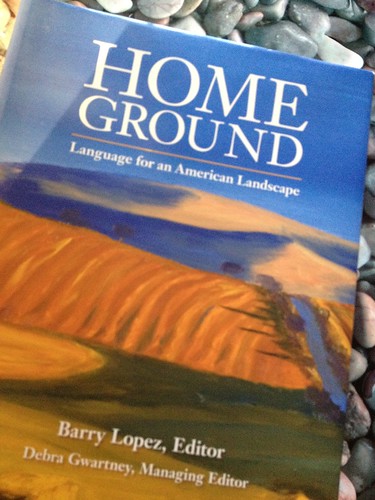
#125: Natural History Reading List #9: 'Home Ground'

Home Ground has an American focus, but would provide a rather fine basis for producing an illustrated glossary of UK specific Natural History terms in the same vein.

I am sure that many of the terms are also relevant to the UK's diverse landscapes.

The book was compiled and edited by the late great Barry Lopez and his partner Debra Gwartney.

Around 100 pages of the book can be read on Google Books here.

The book has definitions of landscape terms - some of which will perhaps be unfamiliar to non-geographers, and not all of which can be found in the UK.

This is a rather wonderful book.
It is a 'dictionary' of features which make up the landscape of the United States.

Many of the landscape terms are illustrated and accompanied by short essays from a range of contributors along with quotes. This is much better than the typical A-Z because of the eclectic nature of the articles and essays and the quality of the writing and illustrations.

Published in America, but available from Amazon.

My copy was published by Trinity University Press in 2006
Hardback, 450pp
ISBN: 1 - 59534 - 024 - 6

Contributors include: Jeffery Renard Allen, Kim Barnes, Conger Beasley, Jr., Franklin Burroughs, Lan Samantha Chang, Michael Collier, Elizabeth Cox, John Daniel, Jan DeBlieu, William deBuys, Gretel Ehrlich, Charles Frazier, Pamela Frierson, Patricia Hampl, Robert Hass, Emily Hiestand, Linda Hogan, Stephen Graham Jones, John Keeble, Barbara Kingsolver, William Kittredge, Jon Krakauer, Gretchen Legler, Arturo Longoria, Bill McKibben, Ellen Meloy, Robert Morgan, Susan Brind Morrow, Antonya Nelson, Robert Michael Pyle, Pattiann Rogers, Scott Russell Sanders, Eva Saulitis, Donna Seaman, Carolyn Servid, Kim Stafford, Mary Swander, Arthur Sze, Mike Tidwell, Luis Alberto Urrea, Luis Verano, D. J. Waldie, Joy Williams, Terry Tempest Williams, and Larry Woiwode.

Wednesday, 27 September 2023

#105: Natural History Reading List #8: Land Healer: How farming can save Britain's countryside

Relatively new in my library is the paperback version of a book by Jake Fiennes, who is currently Head of Conservation on the 25000 acre Holkham Estate in North Norfolk.

This article in The Guardian says a little more about Jake and his work.

It describes the work that has been carried out at Holkham, and the earlier work that taught Fiennes the methods that he is now using. I used to be a regular visitor to the Holkham Estate when a relative owned a caravan which was located there, but he sadly sold out.

This previous article from December 2021 explores some of his conservation work on the coastal marshes on the Holkham Estate.

He has also been profiled in 'The New Yorker'. Limited viewing possible.

The book explores some of the projects that Jake has instigated, and makes suggestions for how farming can make a difference in a positive way. It provides a hopeful message for the way that farming could be - sadly the Government and those in charge of the crucial departments aren't listening to the right people it seems.

#643: The Path More Travelled

A cross posting from my Geo Library blog project - what do you mean you haven't visited? There's over 700 books that would be of in...