Showing posts with label Natural History. Show all posts

Sunday, 23 August 2026

#664: Tom Gauld and Peter Brookes

I'm a big fan of the work of cartoonist Tom Gauld.

Along with several other newspaper / syndicated cartoonists they sometimes turn their attention onto Natural History.

The most obvious cartoonist to do this is Peter Brookes.

His Nature Notes cartoons have been appearing for over 25 years!

A collection of suitable cartoons would make a good resource for teachers, to help students think critically about changes in nature.

Friday, 14 August 2026

#649: Natural History Reading List #28 - 'The Story of Nature'

This is an academic and lengthy read, and a heavy dense book by Jeremy Mynott.

I have been reading it slowly for the last year or so, one chapter at a time.

This review has some useful details.

We talk about ‘nature’ all the time, but what exactly is it? Does nature include physical processes such as rocks and rivers, as well as life? Is humankind part of nature or is there now a clear separation between the artificial and the natural? And if the latter, when did that divorce take place? Nature has a deep history, and what we think about it today may be different from how it was viewed in the past (there have been changes in perception even in my own lifetime). Who invented nature anyway?

There's another useful review of the book here.

It explores some of the early relationships that people had with nature and how those relationships have changed. I was interested in the chapter on cave paintings for example, and the relationship that we had with nature in those times.

Introduction:

What is ‘nature’? Has it always meant the same thing? Are we a part of it?…This is a huge subject, of course, and it would be impossible to write a comprehensive and systematic account of it in a book of this length — or indeed any length. But…stories offer a different way of finding routes through such a vast, varied and difficult terrain and my story is only one among many possible ways of tackling this theme.


Thursday, 13 August 2026

#647: Mary Oliver

The poetry of Mary Oliver has come up a few times in recent weeks.

This poem was mentioned a few times.


Are you familiar with her work?

What other poems are potentially relevant for a perspective on the natural world?


#646: Field Studies Council Virtual courses

The Field Studies Council has made a lot of free online courses available. These explore a range of habitats and types of animals. These are two of the focus areas of the proposed subject content which are currently out for consultation until early September.

Some of these would be of potential value for teachers who want to upskill themselves and prepare to potentially teach aspects of natural history with which they are not familiar.


Saturday, 8 August 2026

#643: The Path More Travelled

A cross posting from my Geo Library blog project - what do you mean you haven't visited? There's over 700 books that would be of interest to geographers.

'Absorbing and exhilarating . . . This book will literally expand your horizons' MICHAEL PALIN
'A panoptic, deeply researched and compelling history of our nation' PATRICK BARKHAM

This was the book I finished at the beginning of the summer break.

It's a chunky tome from Nicholas Crane which sits alongside his earlier book on the making of the landscape of Britain.

It explores the origin of the paths and tracks that run through England, from their first makings as the landscape was populated with the first arrivals. 

The paths firmed up with foot traffic and created a network of paths connecting settlements as they developed. Horses expanded the network, and trade turned them into roads. They were joined by trains and canals and then the car changed everything.

It's scholarly and accessible and full of incident and detail, taking you through the thickets of ancient woodland and out to the development of motorways and the current issues we face travelling through the countryside, including past struggles to gain access to open access land.

Details from the publisher:


In The Path More Travelled, acclaimed geographer and travel writer Nicholas Crane explores the hidden history of Britain's coast-to-coast web of footpaths, from the icy Cairngorms to the banks of the Severn (where he discovers footprints left over 7,000 years ago). 

Witty, wide-ranging and passionate, this is an enchanting call to rediscover and protect the lifeblood of our landscapes.

My copy was published by W&N in 2026

Hardback, 432pp

ISBN:  978-1399605816


If you want to hear more about the book, Nicholas Crane is doing a series of events around the country, including a talk in King's Lynn at the Town Hall.

Your best option if you live in the East of England is to come along to our Christmas social event on Tuesday the 8th of December.

It will be hosted by Norwich School.

Nick will have a focus on the ancient footpaths of East Anglia as well, given the location of the talk, and the fact he was born in Cringleford - a few miles from where my daughter lives - and grew up in the area.

My ticket is booked, so I will see you there and may even help you get some sausage rolls and brownies once the talk is over. We usually have mulled wine on arrival as well...

Thursday, 23 July 2026

#634: A podcast with Caroline Lucas and Mary Colwell

Shared by the Green Alliance.

After more than a decade of campaigning, a natural history GCSE for England is finally on the table. In this special episode, former MP Caroline Lucas and conservationist Mary Colwell sit down to unpack the government’s new consultation: what it gets right, what it’s missing and what bumblebees have to do with it.

A new Podcast with Mary Colwell.

A transcript is available.

Mary's views on the consultation document:

Yeah, there’s lots to welcome about it actually, and from earlier iterations it’s hugely improved. So it really has shifted, um, the focus back onto studying nature, which is really accessible to you, and I think that is the most important thing. The GCSE has to be grounded in localism. It has to be the nature you see on a day-to-day basis. Now, that might not be puffins and dolphins. It might just be, uh, the worms in your garden, the butterflies, the bees, the street trees, the flowers that grow up in the streets in the springtime. It might be the everyday stuff, but that doesn’t mean it’s lacking in wonder. And so to put the emphasis back on what people will see every day is really good.

I welcome the sense of wanting to be a naturalist has come through a lot more strongly. But where I’d say it was lacking is in two or three areas. One is in the keeping of field notebooks and jottings and recordings, actually physically committing down on paper or electronically your thoughts, your observations, your data.

That’s not explicitly put in there as part of a requirement for the GCSE, and that is so important. There is not a naturalist who has ever lived that hasn’t kept a notebook. And notebooks are not only places to write numbers down, they’re places where you express that connection that we were talking about earlier, which is so important.

They’re places where your interaction, your relationship, personal relationship with what’s before you is recorded, and that psychological process sets in train a whole lifetime of connection. The other thing that’s missing, I think, is a sense of the shifting baseline. And I think until we understand that some of the greatest losses in UK nature has happened within living memory.

In the last 100 years, we have lost 50% of the mass of wildlife in the UK. Until we know that, we won’t make sense of what’s before us now. And that shifting baseline, that sense of "this is normal". You look out of the window and this is what’s normal because this is what you see, as opposed to if you’d looked out of the window 50 years ago, you’d have seen a very different world.

But we just gradually get used to less. We gradually get used to an impoverished world. And so if they could put in some way of tackling the shifting baseline in a way that younger people could talk to the older generation, it could be members of their family or their community. What was it like here 50 years ago?

Listen to it here...

Wednesday, 22 July 2026

#631: Our Broken Planet - now up to ten episodes

The Natural History Museum's Our Broken Planet Podcast has been going for over 2 years now. I posted about it when it had just started, so it's worth revisiting to see what topics have been covered in that time.


The most recent episode looked at what action had been taken about climate change.

Surveys show that most of us are really worried about climate change and we want something to be done. But what?

This series, we’ve explored many ways in which nature is changing in response to human activity and the dangers posed to people and planet as a result. In this final episode, Tori and Khalil explore how people are taking action in the face of the planetary emergency. Along the way, you’ll find out:When has activism been effective?
How do scientists feel about climate change?
One thing everyone can do to start making a positive change

Contributors:Dr Erica McAllister - Senior Curator for Diptera and Siphonaptera (flies and fleas) at the Natural History Museum
Professor Tristram Wyatt - Senior research fellow in the Department of Zoology at the University of Oxford and Honorary Research Fellow at the Centre for Biodiversity and Environment Research
Alessandra Korap Munduruku - Member of the Munduruku group of Sawré Muybu, an indigenous territory in northern Brazil, and President of the Pariri Indigenous Association
Dr Rim Saab - Social psychology lecturer at the University of Sussex, who specialises in the psychology of political action

Tuesday, 21 July 2026

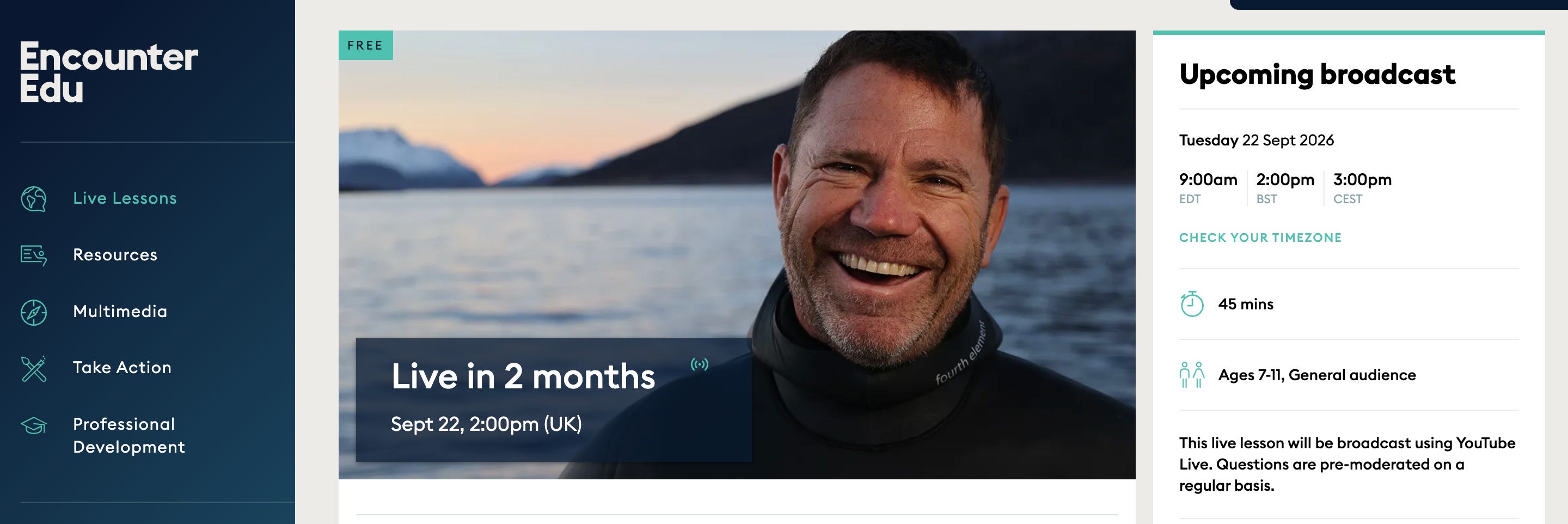
#628: Live lesson with Steve Backshall

Encounter Edu have organised a live lesson link up in September with Steve Backshall as part of Ocean Live.

The live lesson is on Tuesday 22 September, and will be pitched for ages 7-11, with all welcome to join.

We’re thrilled to launch an exciting new live lesson series, Ocean Live with Steve Backshall. Engaging young people with our ocean is one of the things Steve cares about most, and this series marks the start of a brand-new partnership with Nekton, an incredible ocean exploration charity using the latest technology to understand and protect our seas.

Join us live from The Deep on 22 September, as primary schools across the world tune in for the first broadcast.

Live from DEEP Campus, the UK’s leading underwater training and innovation centre, Steve will explore the cutting-edge technology opening up new frontiers in ocean exploration, and speak to the science team behind some incredible new species discoveries.

Expect live quizzes and interaction, segments on tech, exploration and discovery, and a full set of classroom resources and activities to extend the learning long after the broadcast ends. This live lesson will also be broadcast on Children United.

Further details to be confirmed over the summer ahead of the new academic year, but we wanted to get this in your diaries now.

Wednesday, 15 July 2026

#618: BBC - Evolution - Series 1

The BBC's new Evolution series is now up and running.


Evolution is co-produced by The Open University and the BBC, and supported by leading OU academics specialising in evolution, ecology and the history of life on Earth.

Through Chris Packham's journey, the series explores the extraordinary story of life on our planet, from humble origins to the complex creatures we see today, shaped in surprising ways by the unstoppable force of evolution.

A free OU poster is available.

The series has good reviews.

Friday, 3 July 2026

#606: Stephen Collins on Beaver reintroduction

A super cartoon from Stephen Collins who has a lovely style and tackles cultural and everyday issues in a creative way.


Check out Instagram and other locations to find his work.


Copyright: Stephen Collins.


#605: Natural History for Wales?

A member of the Welsh Senedd has called for the GCSE Natural History to be introduced in Wales.


Lindsay Whittle, the Plaid Cymru MS for Blaenau Gwent, Caerffili and Rhymni, raised the issue during questions to the Welsh Government’s Cabinet Secretary for Education, Anna Brychan, in the Senedd.

Sunday, 21 June 2026

#598: Biodiversity Heritage Library - an amazing resource

The Biodiversity Heritage Library was featured in The Guardian yesterday.

There is a very large Flickr library of images which are scanned from the original documents and arranged in albums. These are from expeditions such as Erebus, and into the Antarctic.

There are some excellent images from historical manuscripts.

As well as published biodiversity literature and journals, there are letters, illustrations, climate records, field diaries, ecosystem profiles, distribution records and manuscripts containing the original collecting stories of a particular species or detailing voyages of discovery.

The story was linked to a suggestion that AI might help save endangered plants.


Check the website of the library for more details.

What are your favourite albums in the collection?

Friday, 12 June 2026

#591: More coverage of the draft subject content conultation

More coverage of today's announcement in a few other places.

The TES covered the announcement.


Education secretary Bridget Phillipson
said: “As we move into a world where careers are being increasingly shaped by science, technology and environmental change, it’s crucial young people have the skills for the jobs of tomorrow.

“This new GCSE will help students build a strong understanding of the natural world, alongside the knowledge, skills and hands-on experience to access careers in some of the UK’s fastest growing sectors.”

She added: “With extensive fieldwork built in, the GCSE will also get young people out and about exploring local parks, rivers and more - a critical part of childhood as more and more of our worlds are taken up by screens.”

Dr Doug Gurr, director of the Natural History Museum, said there was a “strong demand” from young people for learning more about nature.

He believes the new qualification could help “equip a generation with the knowledge, skills and confidence to create a future in which people and planet thrive”.

Doug Gurr, the director of the Natural History Museum wrote in the 'Daily Telegraph'.


Bridget Phillipson visited the Natural History Museum today to launch the consultation.


We've had a good surge of new members on the GCSE Natural History Facebook group - and are now up over 900 members.

Wednesday, 3 June 2026

#588: UK wildlife on British banknotes - the shortlist.

The shortlisted animals which may appear on bank notes from the Bank of England have been revealed.


The replacement of historical characters, particularly Sir Winston Churchill, with British wildlife sent political leaders into a frenzy of condemnation earlier this year.

But now people have a month to offer their views about which species of wildlife should be honoured on the £5, £10, £20 and £50 notes.

The shortlist, chosen by a panel of wildlife experts, excluded household pets. People will be able to vote for up to six of their favourites from the shortlist, external.

The mammals are: the bottlenose dolphin, the brown hare, the European hedgehog, the grey seal, the pine marten and the red fox.

The second category of birds feature: the Atlantic puffin, the barn owl, the common kingfisher, the Eurasian curlew, the great spotted woodpecker, and the white-tailed eagle.

The final section of amphibians, insects and fish, has: the Atlantic salmon, the basking shark, the buff-tailed bumblebee, the common frog, the Emperor dragonfly, and the marsh fritillary butterfly.

Tuesday, 26 May 2026

#585: Access to the stones

A cross posting with my World of Music blog.

There are a few locations where the labours of people from prehistory can still be seen.

The idea of following the story of human impact on natural history is part of the draft specification and one would assume it might follow through into the next iteration of the specification as one of the particular aspects of the new qualification.

Historic Environment Scotland (HES) is apparently considering charging to access some of the more well known locations they manage, including the stones of Callanish / Callanais on the Isle of Harris/Lewis. I visited many years ago.

One programme which is behind the increased interest in the area is a time-travel fantasy called 'Outlander'. This has proved very popular.

Cruise ships can arrive at some of these fragile locations in large numbers, which adds additional pressures onto fragile environments.

This album was recorded by the New Zealand musician Jon Mark in 1988 and is named after the ring at Callanish.


And here's a slightly different stone-circle related song...

Monday, 11 May 2026

#578: Deepdale Podcast

I am fortunate enough to live close to the North Norfolk coast. I used to live on the coast itself at Snettisham for 12 years which allowed me to cycle to the beach. 

On the edge of the village is Ken Hill, which has latterly become a venue for Springwatch and a regenerative farm.

The Deepdale Podcast is now live, and there are several posts which would be of interest.

Friday, 8 May 2026

#576: The path more travelled

 I'm currently reading Nicholas Crane's new book on the history of Britain's footpaths: how they came about originally following the drowning of Doggerland, and were then refined by successive waves of change: horses, the Roman invasion etc. It's a dense and scholarly work, with plenty of points of interest and relevance to geographers exploring the connections between people and the landscape.


He's taking his book on the road in a series of talks, with three confirmed so far. Here's the description for his talk at Stanford's book shop at the end of the month. He's also speaking in Exeter and Stamford.

Walking is a cornerstone of British identity and the most popular form of exercise in the UK. But how much do we know about the paths that we walk? What is their history? Why do they follow the routes that they do? Are they permanent? Can we designate more of them?​

The Path More Travelled is a coast-to-coast history of footpaths from the stone age paths walked by migrants 12,000 years to the industrial revolution and the birth of map and walking apps – from beloved writer and broadcaster Nicholas Crane.​

In The Path More Travelled, acclaimed geographer and writer Nicholas Crane explores this coast-to-coast web that is both ancient and futuristic. Starting with the stone age paths walked by European migrants 12,000 years ago, he traces their development - from early pilgrim paths and coffin tracks, through to the industrial revolution and the birth of the bicycle and car, sat-nav and walking apps. We discover how land-grabbing Norman barons set a precedent for the enclosure of our countryside, and how out of the ashes of World War Two came our beloved national parks. 

Along the way, Crane takes the reader on some of his most memorable walks, including the Hadrian's Wall Path, the outer reaches of the Cairngorms, and the banks of the Severn where he discovers footprints from over 7,000 years ago.​

From one of our most beloved travel writers, The Path More Travelled is a passionate ode to footpaths and a call to rediscover this most fundamental part of our landscape.

Book a ticket here.

#575: Happy Birthday Sir David!

On David Attenborough's 100th birthday.

 
A century of storytelling and curiosity...


Tuesday, 14 April 2026

#566: A new OCR Blog on Nature Education in School

This is an excellent blog by Kim Polgreen and Joe Boyle of the University of Oxford. 

It was written for the OCR Blog and relates to the continuing preparations for the GCSE Natural History.

There's a focus on what Secondary schools can do in their own grounds and at low cost to offer potential for students to develop their thinking around natural history and its value.

They say:

From what we see in our own community in Oxfordshire, the fact that the GCSE has been mooted and now been confirmed has changed the conversation. Natural History is now a legitimate subject for teenagers to study at school.

And while we wait and prepare for the GCSE, there is a growing recognition of a more urgent set of “business drivers” for secondary schools to engage with nature and promote nature education. Student stress and mental health problems, student absence, teacher retention, inequality of attainment, parent stress, and even excess building heat and outdoor heat in the summer – these are all becoming overwhelming challenges for school leaders that can be helped by nature.

The blog refers to some research they have done on the way that young people relate to nature. The research is linked to here.

It finishes with 7 principles for working with young people...

These aim to help teachers and schools take advantage of cited opportunities: for wellbeing, skills development, brain development, alternative settings for learning and community building.

These are excellent and the emboldened bits are the the bits I like the most. I think some resources which relate to these would be very useful going forward.

We await the first draft specification for further consultation.
  1. Experience nature first-hand. Hands-on is much much better than pictures. Contact with soil and plants supports gut health. Different outdoor spaces support different students.
  2. Address key school issues. Thoughtfully-designed nature engagement activities can be used to build confidence, resilience, community, attendance and attainment, with benefits resonating through the school community.
  3. Work close to school. Nature is everywhere. Lack of funds for a big trip doesn’t preclude getting out into nature locally or in school grounds. There are lichens on the school walls, a huge variety of species on playing fields and verges, and birds everywhere. A pile of dead wood or a small pond creates a mini ecosystem. Visiting areas near school, within the students’ own environment, cultivates place-based connection.
  4. Diversify views of nature. nature can be studied through science and geography, but also through art, literature, history, drama, religion, philosophy, economics and maths. Examining the varied interrelationships between humans and nature through human history offers many entry points.
  5. Embrace co-learning. Teachers don’t need to be experts, they can become learning coaches, discovering with and from their students, using the many tools available. Nature is such an immense topic that we’re all learning all the time.
  6. Mediate with care. nature engagement is best when it’s led thoughtfully: managing expectations, involving students in risk assessments, accepting variable behaviour and remaining calm and confident will build students’ confidence and enjoyment, and support their ability to learn.
  7. Work together and celebrate difference. People approach nature in different ways. Some are quiet observers, others are active workers. Nature spaces can help collaboration, allow individuals to thrive, and develop mutual appreciation and respect.
And check out the wider work of the Leverhulme Centre for Nature Recovery.


Tuesday, 10 February 2026

#549: New Natural History Centre at Heligan

Details are here:

A NEW educational hub dedicated to championing the cause of nature has opened at a tourist attraction in Cornwall.

The Centre for Nature Futures at the Lost Gardens of Heligan, near Mevagissey, was launched in front of an invited audience of educationalists and business people.


Speeches were given by Heligan co-founder Sir Tim Smit, Heligan chief executive David Harland, head of Nature Futures Dan Ryan and Mary Colwell, a conservationist and naturalist who has led a campaign to introduce a natural history GCSE to the national curriculum.

#677: WWT Welney Reserve and Peter Scott

Another location which will feature in the list of possible places to visit for those schools that choose to offer the new specification and...