Showing posts with label Rivers. Show all posts

Sunday, 4 October 2026

#702: Drought

Drought is a threat to many native species and is therefore connected to natural history.

Droughts are defined differently depending on location.

From the DEFRA website.

There isn’t a single definition for drought so whilst it’s caused by a period of low rainfall, the nature, timing and impacts on people, the environment, agriculture or business will vary.

Some droughts are short and intense, caused by a hot, dry summer. Others are long and take time to develop over multiple seasons due to low amounts of rainfall accumulating.

The main types of drought, which may occur separately or together are:
  • Agricultural drought – when there isn’t enough rainfall and moisture in soils to support crop production or farming practices such as spray irrigation.
  • Environmental drought – when lack of rainfall has a detrimental impact on the environment and ecology.
  • Water supply drought – when a lack of rainfall leads to concerns from water companies about supplies for their customers.

The Summer of 2022 saw a prolonged drought, which had a great impact on grass everywhere. 2026 was worse....

Grass is at least fairly tolerant of drought as it grows in a particular way which means it is often protected from threats such as drought and fire.

Other plants are perhaps less tolerant, and it was a struggle to keep some plants alive.


Image: Alan Parkinson

Friday, 21 August 2026

#656: Big River Watch - back again in September

 The Rivers Trust is running their next Big River Watch between the 18th and 24th of September.

Twice a year, anyone can take part in these week-long citizen science surveys that help to build an important picture of river health across the UK and Ireland. Our rivers are far from healthy. They’re polluted with sewage, plastic, chemicals and nutrients, and just 15% of river stretches in England are in good overall health.

With the Big River Watch app, you can help identify the issues, which help’s the Trust influence policymakers and hold polluters to account. After the drought of this summer, many rivers are at low levels of flow, and my local chalk stream the River Nar is running at very low levels which is not good. To take part you need to download the app, which is free

This would be a good Citizen Science opportunity for students to participate in.

Download the app and head for your nearest river. Mine is about 2 minutes walk away luckily.

Spend 15 minutes watching the river, and answer the questions in the survey. You can complete the Big River Watch at your favourite local spot, or get to know somewhere new. The survey will ask you about what you see, from wildlife and plants to any signs of pollution. Not sure what you're looking at? The in-app pollution and wildlife guides can help you make an identification.

Saturday, 18 July 2026

#627: Canal and River Trust

I've blogged about this organisation previously, and also my liking for Robbie Cumming's 'slow' exploration of the UK in Canal Boat Diaries (available to stream on 'U' channel and app.) Earlier series are also shown on iPlayer.

The Canal and Rivers Trust don't just look after the network, they are also concerned about the biodiversity that is sustained by it.

Image: Canal basin, Wakefield - Alan Parkinson - shared on Flickr under CC license

Tuesday, 26 May 2026

#582: Otter Valley Association

The Otter Valley Association was founded in 1979.


The OVA is a civic society founded to interest residents and visitors in the history, geography, natural history and architecture of this area of Devon. The OVA covers the area of East Devon from Newton Poppleford and Harpford to Budleigh Salterton following the River Otter down to the sea.

We visit the River Otter every summer during our holidays down to Devon, where we always end up in either Otterton or Budleigh Salterton or some other location along the river's course.

Tuesday, 3 March 2026

#554: River Glaven

What is your local river? Can you get out to it to do fieldwork easily?

What fieldwork would be appropriate for the GCSE Natural History?

One river that I have completed fieldwork on most recently is the River Glaven.

This is a fairly short river which flows through North Norfolk.

Rising from tiny chalk headwaters in lower Bodham and Baconsthorpe, the River Glaven flows for approximately 17 km. Its main course begins just below Selbrigg Pond, where three tributaries combine at the outfall. From there, the river winds through wooded hills of glacial debris, traverses lush countryside, and meanders through picturesque flint villages, before meeting the sea behind Blakeney Point.

Image: Selbrigg Pond, where the Glaven comes to life.

I have followed the river for most of that route.

At Letheringsett mill there is a useful stretch where fieldwork can be carried out.

Image: Letheringsett

The River Glaven faces challenges from abstraction, climate change and development. These pressures affect water levels and temperatures, ultimately impacting the wildlife and communities that depend on this precious chalk stream.


Images by Alan Parkinson.

Thursday, 16 January 2025

#426: Nice beaver...

There are wild beavers within 15 minutes of my house.... they are active at Sculthorpe Nature Reserve in Norfolk.

These local initiatives are part of the Beavers and Biodiversity Gain Project.


In September 2019, after a successful application to the Green Recovery Challenge Fund, the Trust secured a grant.

The project was in two stages, based at the Sculthorpe Moor Nature Reserve – Norfolk.
  • Creation and reintroduction of Beaver area.
  • The diversion of flood water from the Wensum to Hempton Moor, south of the Reserve, and enhancing its wetland habitat (reedbed & ponds).

Wednesday, 20 November 2024

#400: What's SUP?

Paddle boarding is growing in popularity.

Imagine a field trip where the method of transport is a stand up paddle board?

There is a Paddler's Code to adhere to, to avoid disturbing wildlife.


Monday, 28 October 2024

#388: Riversong

Riversong is here, and free for anyone to use.


Monday, 25 March 2024

#268: Nature has rights - or not...

Another new low from the UK government from a week or so ago, which I've just got round to posting here... there've been quite a few other related stories as well.

This Guardian article has been retweeted a number of times over the last few days, with the same sort of response from a great many environmental organisations and campaigners.


“It’s paradoxical because it recognises rights for non-human entities like corporations but denies them to non-human living beings. It’s contradictory because, while rhetorically acknowledging different cultures and Indigenous worldviews, it nevertheless imposes the western understanding of rights and law,”

Robert MacFarlane has written on the fact that rivers were recognised as being a living thing, and Patrick Barkham has also written for The Guardian on this theme.

Friday, 13 October 2023

#122: Canal and River Trust

The proposal documents for the new Specification list a number of supporting organisations. This is one of a series of posts exploring these organisations and what they might offer for those teachers who are thinking about offering the new specification and qualification in their schools and institutions.

It would also make sense to check out what the options are for your nearest stretch of water. I am fortunate to 


The Canal and River Trust is involved in the management of the nation's waterways.

The website also features a section on invasive species.


Scroll to the bottom and you can see a nice representation of what they believe rivers can look like...


These are worth looking at for a whole range of natural history related reasons. They are designed for Primary in particular but there is something there to work on.


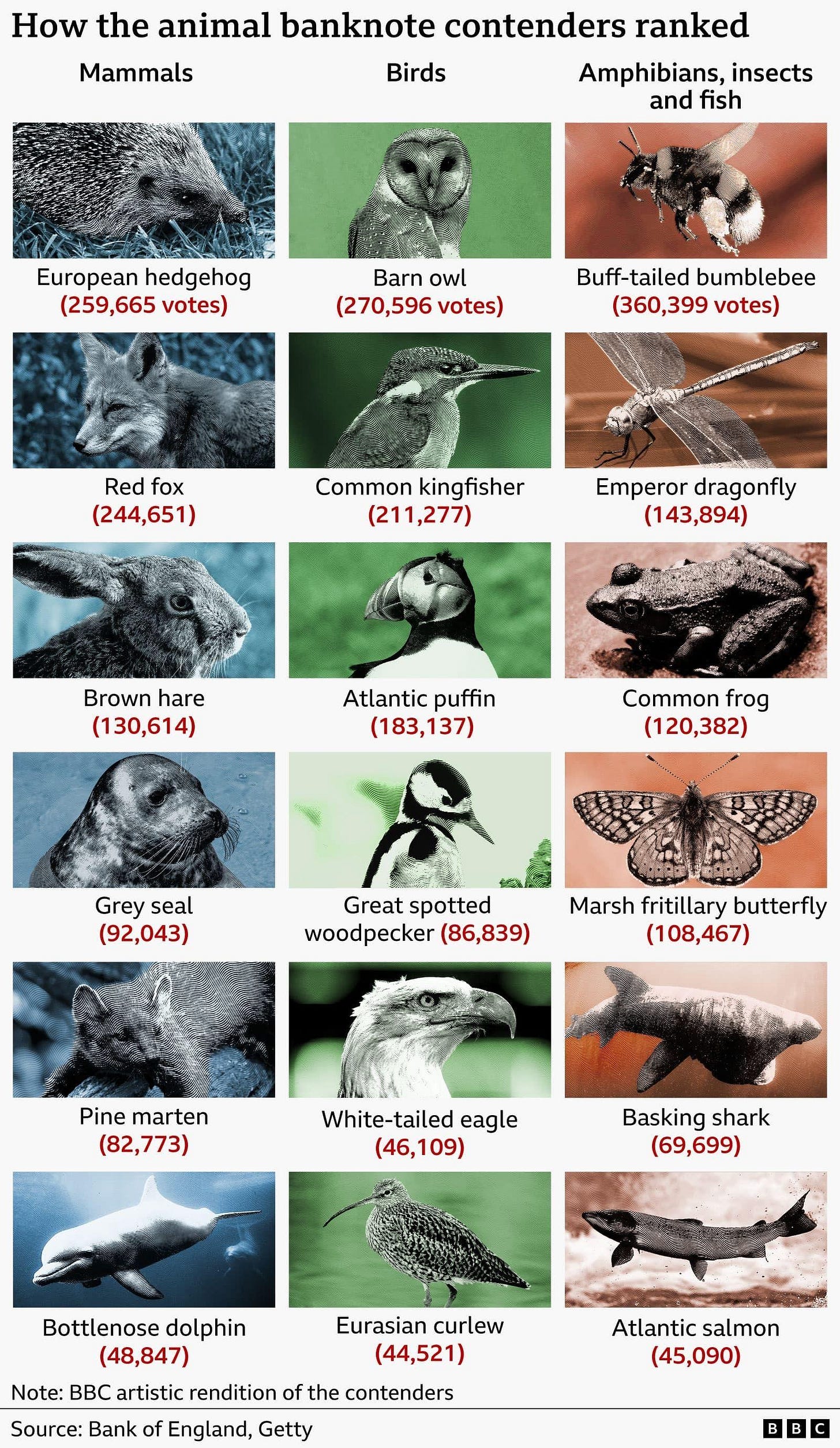
#703: Animals on banknotes

Following a public vote, which attracted over 2 million votes in total, four animals have been selected to appear on English banknotes. The ...