Showing posts with label Representations of the Natural World. Show all posts

Tuesday, 10 February 2026

#550: Threatened rock art

The Vingen Quarry in Norway has a range of threatened rock art.

This Guardian article from 2024 explores the reason why such sites should be protected.

Rock art falls into the category of "representations of the natural world".

Wednesday, 30 July 2025

#477: Stained class... what windows can you spot?

Following my suggestion of a collection of postbox toppers, I have another suggestion for a collection of representations of nature: on stained glass windows in churches.

These are likely to be in some of the modern manifestations of this art form perhaps.

The idea came from this window which I saw at the weekend in Wentworth Church in South Yorkshire.

I love the deer and trees on this window.

Image: Alan Parkinson - shared on Flickr under CC license

What can you spot?

Add them to this Flickr group.

Or send them to me to be added to this page...

Wednesday, 24 January 2024

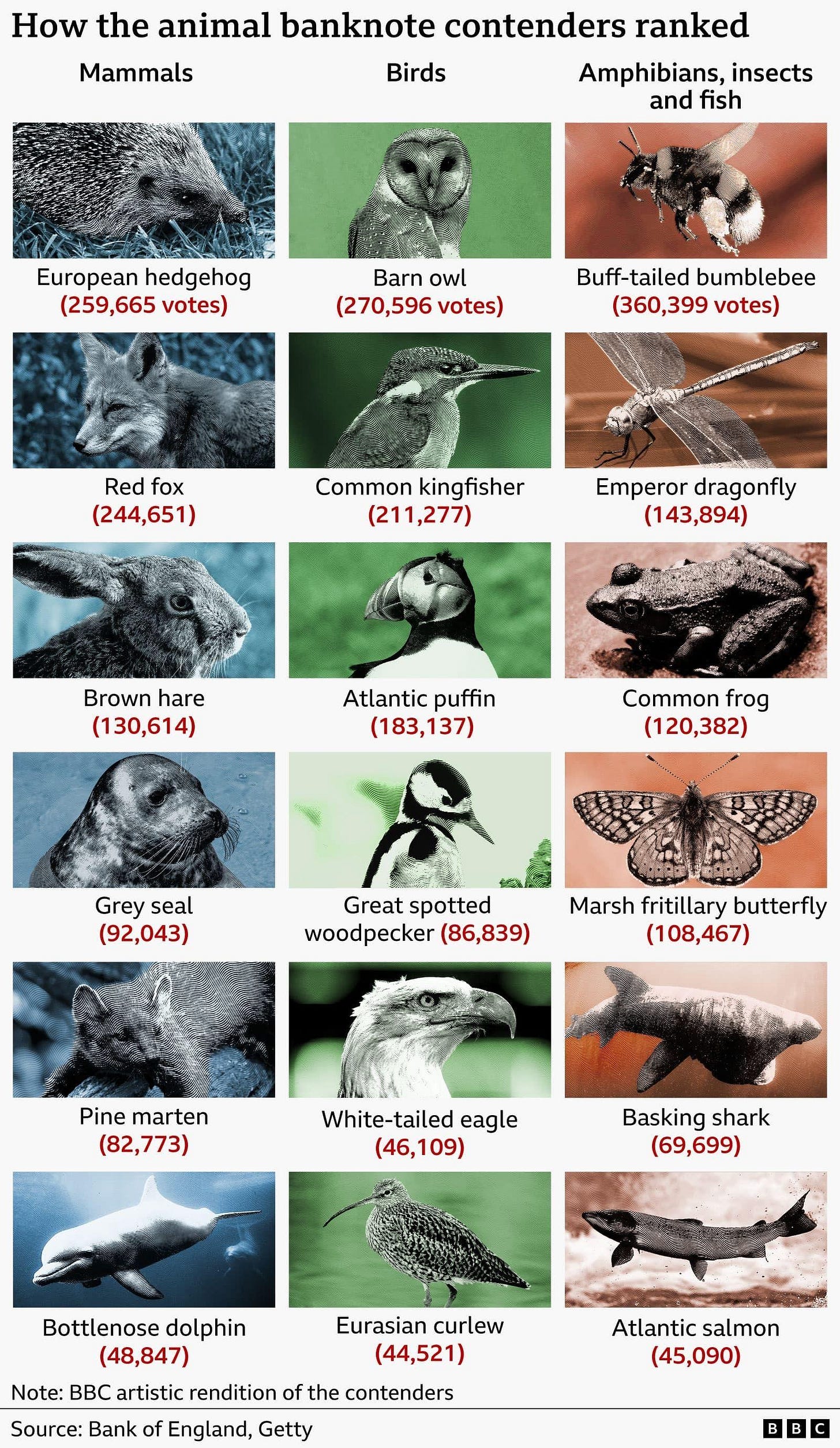
#227: Banking on it

Nan Shepherd appears on the Scottish £5 note. This is one example of Natural History appearing on currency. What other examples can students find?

Here's the story of the design of the banknote. It's been in circulation since 2016. There is a lot of symbology in the image choices for the design.

Nan Shepherd is the author of 'The Living Mountain', about the Cairngorms. It's one of the most influential pieces of nature writing and has influenced othr writers such as Robert MacFarlane.

As well as an image of Shepherd, the RBS £5 note features a quote from the author’s first novel, The Quarry Wood – “It’s a grand thing to get leave to live” – and one from her meditation on the Scottish landscape, The Living Mountain: “But the struggle between frost and the force in running water is not quickly over. The battle fluctuates, and at the point of fluctuation between the motion in water and the immobility of frost, strange and beautiful forms are evolved.”


The reverse of the £5 note features an excerpt from Gaelic poet Sorley MacLean’s poem The Choice, which translates into English as “I walked with my reason, out beside the sea”

The note also features an image of a midge, to “represent the reality of everyday living in the Scottish countryside”, according to RBS. “It’s a reminder that Scottish nature nips us as well as thrills us,” said Macfarlane.

Bonus points too if you can identify the type of fish being shown on the back of the note.

Wednesday, 3 January 2024

#213: Cave Paintings #2 - Cosquer Cave


Another reminder that you can join the dedicated Facebook group for GCSE Natural History here. We have over 750 members of the group now.

One element of the proposed specification is a look back at the early representations of wildlife found in caves and painted many thousands of years ago.

I've been reading Max Leonard's 'A Cold Spell', and he mentions the cave at Cosquer near Marseille.


There was a long human occupation of the Cosquer Cave, from 33,000 BP to 19,000 BP, consisting of two major, almost uninterrupted, phases of human occupation. These dates have been obtained from around sixty Carbon-14 dating tests performed on forty-one samples collected between 1992 and 2012.

The Upper Palaeolithic Period was a period in prehistory that began in Europe when the first Homo sapiens emerged, around 45,000 years ago. The period was characterised by an intensely cold climate, and the fauna and flora adapted to the cold temperatures. The Homo sapiens hunter-gatherers developed various tools, hunting techniques, and dwellings to adapt to this environment. Around 10,000 years ago, the climate became warmer, which marked the end of the Palaeolithic Period.

The Gravettian culture was one of the major cultures of the Upper Palaeolithic Period in Europe. The culture developed from around 34,000-33,000 years ago to 23,000-22,000 BP. It was characterised by its very specific lithic industry, vestiges of which include, in particular, the projectile tips found in the cave at La Gravette, and very specific forms of artistic expression 'Venus’ figurines and negative handprints. The Gravettian geographical distribution was very wide, extending from the Iberian Peninsula to the Dnieper River Basin.

The Cosquer Cave, which was decorated with art at a time when the sea was several kilometres away, is now partially submerged due to climate change. The cave became inaccessible on foot around 9,000 years ago. The site, which has been protected from human intrusion for thousands of years, and which is now recognised as an archaeological heritage site, is therefore destined to disappear.

As with Lascaux, a replica cave system has been built to help protect the original from the impacts of visitors.

Image: Hay Tor - Alan Parkinson, shared under CC license 

Friday, 24 November 2023

#188: Fred Ingrams' Flat Earth

One of my favourite contemporary landscape artists is Fred Ingrams.

He has painted hundreds of colourful representations of The Fens over the years, and others of the Flowlands of Scotland, around Caithness.

The Fens is an area that I will certainly look to write about for any resources that emerge, as an example of a landscape with a particular natural history, which has been shaped in recent centuries by the actions of people.

He has now created a book called Flat Earth. Fred says:

I have been painting the Fens for over a decade, producing around 500 paintings in that period. In some ways I suppose this book can be considered a retrospective. 

I’ve chosen a collection of paintings that I feel have passed the test of time – a showreel of my greatest hits. They do not appear in any particular order and are not chronological. It is my hope that looking at this book feels like wandering through an exhibition of my work.

The hard back book measures 23 x 29cm and is 200 pages long, containing over 100 paintings as well as a foreword by Susan Owens and an introduction written by myself.

I have a copy of a catalogue of a previous exhibition of his paintings which has an excellent introduction by Jonathan Meades. 
A film of Fred at work:

Wednesday, 8 November 2023

#170: Representations of the natural world: cave paintings

Humans have represented the natural world in many different ways over the centuries, dating back to cave paintings through a whole range of other art forms: literature, poetry, art, pottery, gardening etc.

The original ideas in the consultation on the specification included a reference to cave paintings. This may form part of a topic called 'Life in the Early World' or more likely 'Representations of the Natural World'.

There are some famous locations where cave paintings have been discovered, which represent the flora and fauna of the time. The drawings capture creatures which are no longer native to the countries where the images are found. The paintings were also made with dyes / paints made from natural sources as well.

A few key locations which would be worth referencing:

1. Lascaux Caves


Source:https://www.flickr.com/photos/centredessciencesdemontreal/13763665525/sizes/l/

This is perhaps one of the best known locations.

The problem with the caves is that visitors change the atmosphere within the caves, due to their respiration adding heat and moisture to the otherwise cool and relatively dry interior of the caves (which was why people lived there).

There is also a good story starter for a mystery which links with Robot the Dog, who disappeared down a hole and helped to discover the cave system.

Visitors are now directed to a replica of the cave which was recreated following 3D scanning of the original spaces to ensure that they are not damaged further.

2. Chauvet Cave

The Chauvet cave, in the Ardeche region of southern France, contains some of the oldest and most remarkable cave drawings ever found - yet it has been sealed shut since its discovery to preserve this precious art.


The cave is the subject of an early film by Werner Herzog.


In this BBC Sounds broadcast he describes the moment. He describes it as being transported to a separate reality.


What other examples of cave paintings could be added to this list of locations?


#643: The Path More Travelled

A cross posting from my Geo Library blog project - what do you mean you haven't visited? There's over 700 books that would be of in...