Showing posts with label CPD. Show all posts

Thursday, 28 May 2026

#586: Oxford Education Deanery - a CPD opportunity


The Oxford Education Deanery Climate & Nature Collaborative is a two-day professional development course for school teachers, based at the University of Oxford’s Department of Education.

Bringing together leading experts and dedicated educators, the Collaborative offers seven focused sessions designed to deepen your practice and broaden your impact:

  • Natural history approaches, including a session at Oxford’s Museum of Natural History
  • Cross-curricular frameworks with an expert from the UCL Centre for Climate Change and Sustainability Education
  • Research-informed pedagogies for climate and nature education
  • Climate emotions and student well-being
  • Student voices in climate and nature education
  • Subject-specific working groups, culminating in a showcase of participants’ projects and ideas
  • Oxford’s leading Net Zero research and what it means for the classroom

Rooted in the latest research, the Collaborative foregrounds hope, solution-focused thinking, and emotional awareness — equipping teachers with practical strategies that carry directly into classrooms, schools, and communities.

The two days include a dinner at Trinity College, Oxford, lunch on Friday, and time at the historic Museum of Natural History — making this as much a celebration of Oxford’s intellectual and cultural life as it is a professional learning experience.

Booking, programme and all the details here.

Tuesday, 3 March 2026

#553: RGS CPD on Biodiversity

As we move to the next stage of the development of the new GCSE Natural History, there will be a need for teachers to receive CPD in a wide range of new skills and knowledge. This sort of event will be particularly helpful.

How do we protect nature in a rapidly changing world?

Join us on Tuesday 17 March to hear leading conservation scientists and researchers discuss how we can safeguard biodiversity for the future.
  • Professor Nathalie Seddon – Professor of Biodiversity (University of Oxford)
  • Dr Liana Chua – Social anthropologist and Associate Professor in Malay World Studies (University of Cambridge)
  • Dr Joshua Elves-Powell – Associate Lecturer in Biodiversity Conservation and Ecology (UCL) and National Geographic Explorer
Chaired by Martine Croxall (BBC News)

Be part of an important conversation on conservation, climate and the future of our natural world.

Tuesday, 10 February 2026

#549: New Natural History Centre at Heligan

Details are here:

A NEW educational hub dedicated to championing the cause of nature has opened at a tourist attraction in Cornwall.

The Centre for Nature Futures at the Lost Gardens of Heligan, near Mevagissey, was launched in front of an invited audience of educationalists and business people.


Speeches were given by Heligan co-founder Sir Tim Smit, Heligan chief executive David Harland, head of Nature Futures Dan Ryan and Mary Colwell, a conservationist and naturalist who has led a campaign to introduce a natural history GCSE to the national curriculum.

Thursday, 22 January 2026

#548: Remote and face to face - the support we'll need

When the specification is (finally) released, along with SAMs and other support materials and guidance there will be a year or so to prepare teachers to teach the new specification. 

This will require them to upskill themselves (and I include myself in that).

Official and 'unofficial' support and textbooks and other material will start to appear, and the various organisations who have been involved so far will no doubt have their own idea.

There are already some organisations offering free online training - here are a few examples from November 2023 for example, from different organisations... they will of course be offering many more in the years to come...

What do you think will be the most useful types of support that teachers and schools that decide to offer the new specification will need to be provided with - whether by the awarding body or external bodies including publishers, subject associations, charities etc.

Thursday, 9 October 2025

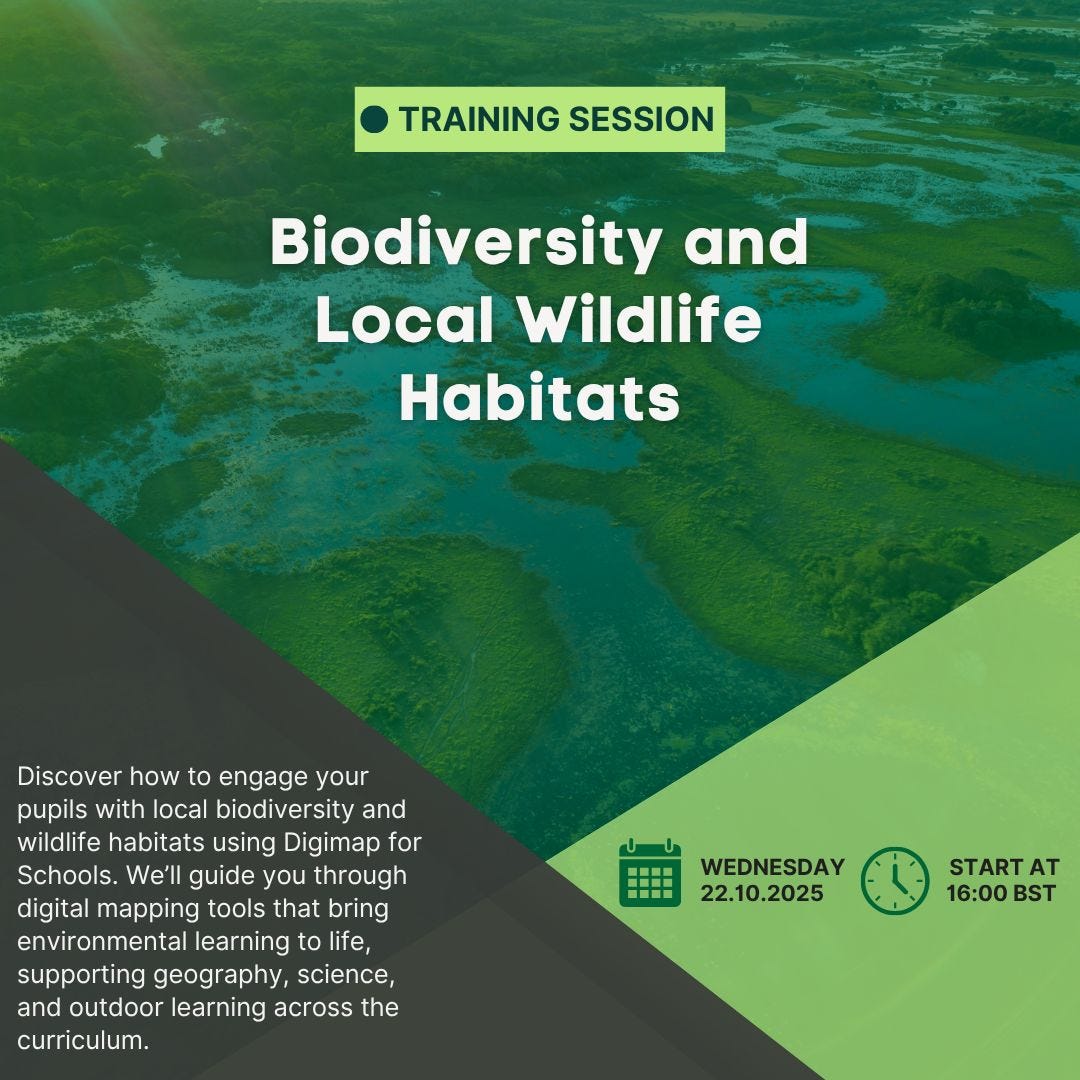
#502: Digimap CPD on mapping local wildlife and biodiversity

A free Digimap for Schools Webinar to help you explore biodiversity and local wildlife habitats. 

This sort of CPD will be valuable for those who have aspirations to teach the new specification.

No alternative text description for this image

Sign up here - it’s free.

Monday, 26 May 2025

#452: New BSSS Podcast

Thanks to Steve Brace for the tipoff to a new podcast from the British Society of Soil Science.


Soil Matters, a platform dedicated to bridging the gap between cutting-edge scientific research and real-world application.

Each episode will feature leading experts, researchers, and practitioners discussing the latest findings, innovations, and challenges in soil science. From exploring soil’s role in climate change mitigation to sustainable agriculture and biodiversity, Soil Matters aims to engage listeners with accessible, thought-provoking content that highlights the importance of soil in shaping our planet’s future. Whether you’re a researcher, policymaker, or simply curious about the ground beneath your feet, this podcast offers something for everyone passionate about soil science.

Friday, 11 April 2025

#441: British Ecological Society Summer School - applications now open

 Thanks to Matt from the British Ecological Society for the message he added to my GCSE Natural History blog.

The British Ecological Society are supporters of the Natural History GCSE and want to be ready to support with the teaching of this qualification. I'm a former teacher myself and now work on their education policy/project work.
We are running our free teacher training again this year. The programme includes a trip to Knepp rewilding project. Anyone who teaches ecology and biodiversity as part of their curriculum should apply. I think it will be helpful if you're preparing to teach this GCSE if we can get it over the line!


The Summer School runs from the 18th-19th of July so would make a good start to the year for many.

Application deadline: Wed 30 April 2025, 12:00 BST (midday)
Online session: Wed 09 July 2025, 16:00-17:00 BST
In-person days: Fri 18 – Sat 19 July 2025
Location: Juniper Hall, Old London Road, Mickleham, RH5 6DA
Applications are now open for the 2025 Teacher Training Summer School!

FREE of charge.

If you are a secondary teacher or FE lecturer who teaches ecology as a part of your curriculum, join us in Surrey for an ecology-packed CPD programme that will help you overcome recognised barriers to teaching ecology. This application is open to all – you do not need to be a BES member to apply.

While attending the Teacher Training Summer School you will:
  • Engage with industry professionals running workshops on a range of ecological skills
  • Network with other educators from a variety of schools and colleges
  • Learn strategies to overcome barriers you may experience teaching ecology
  • Explore how ecology can be taught using a wide range of learning theories: inclusive learning, interdisciplinary learning, strengthening maths and English skills
  • Receive a free bundle of equipment to be used to teach ecology
  • Learn more about field work skills through attending a day trip to the Knepp Rewilding Project

Saturday, 12 October 2024

#381: Broads Society Lecture - October 24th

If and when we are able to move to the next phase of this qualification, teachers will need training and will need to look for national and local organisations offering events which will be suitable for developing our skills in the field of Natural History.

The Broads Society calls itself "the voice for the Broads". 

It is a Society local to where I live in Norfolk, and to a landscape which I am sure I will be using to develop some resources when we get to that stage.

They also offer a series of events... and one sounds useful which is coming up in a few weeks' time.

One for Norfolk and similar folks really due to the location...


The Broads Society has a lecture which soulds like it will be useful.

24th October  2024

‘Innovative Management of the Broads Landscape’

7.30 at Blake Studio, Norwich School.

If interested, please book through Broads Society website.  

This will be an important event looking at mitigation measures for the Broads in the face of the potentially dramatic changes ahead.


Image: On the Broads, by Alan Parkinson, shared on Flickr under CC license

Wednesday, 15 May 2024

#309: Data Skills course at the RGS-IBG

A new RGS course in association with the Field Studies Council may be of interest. 

We've been exploring the various skills that teachers who are going to be teaching the new specification. Handling natural history may well be involved there.

Image: Questionnaire, Alan Parkinson - shared under CC license.

Wednesday, 14 February 2024

#238: Watkins and Doncaster

Watkins and Doncaster are a firm that many schools are likely to be in touch with when they are preparing to teach the new GCSE Natural History specification for the first time.

Any school planning to offer the GCSE Natural History will probably need to purchase a range of equipment for some of the skills and fieldwork elements - if those are retained from the original consultation. It is unlikely that many will have everything they need for the new specification. This is also one additional 'cost' involved for schools which want to offer the new specification and which might therefore prevent some colleagues who might want to be involved from being able to add it to the subjects they offer.

Here's the wording from the original consultation document, which is only advisory and not the final text of course.

Safe use of techniques for monitoring/detecting organisms. For example: Longworth traps, moth traps, camera traps, satellite tags, methods for monitoring reptiles, using photographs, bat detectors, bird ringing, etc. Use of indirect evidence (e.g. signs, tracks, landscape analysis) Use of Identification charts

They will need some equipment for fieldwork and also to train students in the techniques they need - the teachers will need to upskill themselves first of all, so liaison between biologists, geographers and others will be essential...


The firm sells some useful equipment for entomological work (insects) and geology.

Saturday, 25 November 2023

#189: The Harmony Project

 Check out the Harmony Project.

The Harmony Project aims to transform education to ensure it is fit for purpose in preparing young people to engage with the environmental and social challenges we face, not just to pass exams. We work with educators to develop learning that is based upon a deep understanding of, and connection to, the natural world – learning that will equip students with the skills they need to live more sustainably.


The booklet they've created has been designed for primary teachers rather than GCSE students, but the ideas could easily be adapted, and that goes for much of the other resource library on the site.

Visiting the website revealed a whole range of other resources that would be of value to those preparing to teach the new GCSE but also existing subjects including Geography but also English and PSHE.

For example, there's a 90 page pack on Antarctica which has links to videos and other aspects of life on the frozen (for now) continent. This explores our connections with the continent.


Our Natural History is being impacted by change taking place in distant areas.


Thursday, 23 November 2023

#183: Ordnance Survey survey on mapping and GIS

My hope would be that the new specification will involve an expectation of a deal of mapwork using the Ordnance Survey's mapping, plus ESRI GIS mapping and Survey123 for the collection and visualisation of fieldwork data. They may also need to use the MAGIC map, maps of National Landscapes etc and ensure that location and description of context is an important part when considering the range of habitats and how the landscape and Natural History of the UK has changed over the centuries.

I've been involved with the OS in numerous ways over the years: as a GetOutside Champion, author of support resources for Digimap for Schools and Digimap for Colleges / Mapstream. Also as an author of articles for Mapping News and other support for various campaigns and activities.

For many years Ordnance Survey has delivered support for education to encourage the awareness and use of high-quality geospatial data in the education sector and since 2020 this has been through an Education Plan, funded through the UK Government's Geospatial Commission (GC).
They are keen to gather evidence about how this has so far supported the work of teachers and consider what more they could be doing in this area. 

They would also like to understand what other training tools geography teachers currently access and the barriers that may be in place when using geographic information systems (GIS).

They are asking for 15 minutes (or so) of your time to complete a short survey. 

The survey is open to all geography teachers until Friday 8 December and the findings from it will help them to consider how to develop the Education Plan.

Sunday, 1 October 2023

#111: An update from Mary Colwell: watch out for Nature Hubs

A long awaited update, which comes from Mary Colwell.


She describes the delay in the development and signing off of the subject criteria by the Schools Minister Nick Gibb.

"The criteria have now been written by the secret panel (the whole process is secret) and are now submitted and sitting with Nick Gibb, the Schools Minister. Mr Gibb has had them for many months but they have not yet been signed off, there are obviously queries to be answered and there is no time scale given when this will happen. What is certain is that this delay will mean first teaching will now be in 2026, not 2025, as there is so much to do to get schools ready.

It is a complicated business launching a new GCSE, and we know from surveys and communication with schools that there is some concern that teachers feel underconfident about teaching it. Many feel they don’t have the skills, they are worried about resources and are unsure about access to experts and even to wildlife itself."

She rightly says that the National Education Nature Park is part of the plan to make schools into nature reserves.
We are certainly planning to use the school site as a nature reserve.


She goes on to introduce another level of support for teachers who want to teach the new specification.

"Curlew Action sees the need for local, bespoke teacher and pupil training through what we are calling Nature Hubs.

A Nature Hub is a place to go to learn about being a naturalist.

It will offer training in identification skills, fieldwork, field safety, local ecology, and local natural history.


Nature Hubs will, ideally, be all over the country, connecting need with expertise. It is a big and bold idea, and we it needs blended finance to work, but we are working hard to secure it. We are putting time and effort into this as we know nature needs us to act fast."

Tuesday, 1 August 2023

#66: Field Studies Council courses

It's inevitable that those teachers who are going to teach the new (eventually approved) specification will need some training of their own first to ensure that they are ready to feel confident in the classroom. Some of this training will hopefully be provided by the awarding body and be specific to the development of the course, and the assessment. 

I hope that this blog and the Facebook group that we created at a similar time will help in developing a community of teachers who will, in turn, share the resources that they have 

One place to look for training will be your local Field Studies Council centre.

Scroll to the bottom of any page on the Field Studies Council website and you will see a link through to all of the FSC Centres.


Also worth saying that as a long-term moderator for the Geographical Association's Secondary Quality Mark (SGQM)

Wednesday, 12 July 2023

#53: Natural History Reading List #2: A Natural History of Selborne

Updated November 15th 2023

"Gilbert White’s book, more than any other, has shaped our everyday view of the relations between humans and nature."

Richard Mabey, Naturalist & biographer of Gilbert White

Gilbert White's book is a landmark text which students of the GCSE in Natural History are likely to be introduced to in some way. It was a great inspiration for other writers who are at the heart of natural history as well, including Charles Darwin.

His house is open as a museum.

Gilbert White was the curate of the Parish of Selborne in Hampshire and lived there for 40 years. He started his work with his Garden Kalendar in 1751. He and his brother cut a path, called the Zigzag, into the hill behind the house where Gilbert lived, leading up onto the Common.

White is widely regarded as the father of ecology, and is a globally significant natural scientist. He was responsible for a number of major discoveries in the world of natural history

White is famous because of his method. 
In an age without cameras and tape recorders he correctly identified the willow wrens as separate species by their songs and by minute differences in their plumage. He did this through observation, what he called ‘observing narrowly’, and then carefully recording what he saw. 
Whereas other natural historians of the 18th century received information from all over the country, White closely observed nature in one patch of country, as modern natural historians do. He would receive specimens from local boys, or from his brother John, which he would examine. His scientific fame rests on his minute observation of all nature in his garden, on his walks and his rides in the countryside.

Some text amended from the museum website.

Simon Barnes, in The Times 1st June 2013 wrote: 

‘The book is about taking small things and understanding their place across the immensities of space and time. He was able to take a small localised matter and see its eternal significance. He saw his little chunk of Hampshire as a single living entity".

The book takes the form of a seriesof letters to Thomas Pennant and Daines Barrington, and was published in 1789 near the end of his life. 

Gilbert White also referred to the "rude magnificence" of nature.

Updated July 28th 2023

A nice piece in 'The Guardian' explored more of Gilbert White's legacy and how some the 'rude magnificence' has been restored.

It also gave me an idea to put together a GCSE Natural History Quiz as part of the resources that we will be creating around the specification.
One question would be to name Gilbert White's pet tortoise.

The article also goes into the skill of "watching narrowly" and the conservation work being carried out on the estate.

The book has never been out of print since publication.
The Linnean Society offered a session in November 2023, and a link to watch the YouTube recording was provided...


Monday, 2 January 2023

#2: OCR"s Natural History Hub

At the time of starting the planning and draft posts for this blog, the awarding body OCR set up a hub to share the work that is being done so far on the qualification and the development journey of the progress towards the official approval. 

I presume that updates will appear here first, so I have followed the various accounts and also set up Google Alerts for various terms.


A Cambridge Assessment seminar provided the following detail on the new GCSE:

Environmentalist and campaigner Mary Colwell began working to address a gap in education content in relation to nature and our environment nearly 10 years ago. In 2019 she began exploring how to make this vision a reality and gathered the support of MPs, environmental organisations and over 10,000 signatures on a UK Parliament Petition for the development of the secondary school curriculum. 

With the support of Tim Oates CBE, Director of Assessment Research and Development, Mary has worked closely with OCR and Cambridge Assessment, the Natural History Museum, The Wildlife Trusts and others to explore the purpose, design and delivery of a GCSE in Natural History. In 2020 a proposal was submitted to the Department for Education (DfE) for the development of this new qualification. 

At this Cambridge Assessment Network seminar, Mary addresses her reasons for embarking on this campaign, including the lack of understanding of nature and its impact, the challenges we face in the future and the important role education can play in overcoming them. 

She is joined by Tim Oates to discuss the process of developing a proposal around this new qualification and the steps involved in helping to shape early thinking about what a Natural History GCSE might look like.


There was a consultation which had the following results:

Keep an eye on this over the year(s) to come as this will be an important element of the development work that is under way.

#643: The Path More Travelled

A cross posting from my Geo Library blog project - what do you mean you haven't visited? There's over 700 books that would be of in...