Friday, 14 November 2025

#516: UK Soil Observatory Map Viewer

The UK Soil Observatory has a Map Viewer. 

This will be of  particular value when students are exploring the vital material that is soil - more of that in other related blog posts.  Soils were one of the topics that I focussed on in my undergraduate studies. There were also some connections with the work I did on various mass movements in the north of England.

Soil is significant as 

Land Cover Maps can also be created and download.

Thursday, 13 November 2025

#515: Norfolk oysters and lobsters

Norfolk has some excellent seafood and some very good places to buy it.

Think Norfolk and you think of Cromer crabs, or brown shrimp caught by boats which head out from the Fisher Fleet in King's Lynn.

There are several projects aimed at developing 

Norfolk Oysters

Oysters are getting a new reef off the Norfolk coast where they can live and grow according to a report from September.

This is a man-made structure, but will help the oysters grow.


Norfolk Lobsters

This project is rearing lobsters and then releasing them when they are still very small, so that they can repopulate the Wash off the coast of Norfolk.


Discover the Wells Harbour Lobster Hatchery, where we’re dedicated to sustaining the local lobster population and preserving Wells’ rich fishing heritage. Through our innovative rearing practices, we boost lobster survival rates and support a sustainable fishery, benefiting both the marine ecosystem and local fishermen. Our hatchery is also a centre for research, education, and community engagement, offering tours that provide a unique glimpse into marine conservation. Join us in our mission to protect Wells Harbour’s marine life for future generations.

Both of these projects are aimed at increasing the sustainability of the local seafood industry. A whole variety of coastal pubs and restaurants are keen to secure fresh produce.

Sunday, 9 November 2025

#514: Soil loss

Jay Owens wrote a book called Dust; the Modern World in a Trillion Particles.

'Owens's pursuit of dust - defined very broadly as particles of a certain size, however generated - sends her tripping through many fascinating and rewarding realms . . . She's a superb travel writer, delivering with aplomb on her own idea of what geographers should be doing: Paying attention to tangible, material realities to ground our theoretical models in the world.' - Telegraph

Listen to Jay Owens on dust... a nice short listen on Radio 4's Four Thought:

Jay has spent years researching dust, and produces a popular newsletter on the subject. In this fascinating Four Thought, recorded at the Design Museum in London, she shares some stories from the field of dust research that up until now have only been known to other 'dust people', as she calls her fellow dust researchers.


Dust is also the subject of a book in the Bloomsbury Object Lessons series, which I've mentioned before and am a great fan of...

Jay studied for a Masters in ‘Modernity, Space and Place’ (Geography) at UCL 

Wednesday, 5 November 2025

#512: Curriculum and Assessment Review - final report


The final report of Becky Francis' Curriculum and Assessment Review was published today.

The DfE's official response to the recommendations in that review can be seen here.

It includes this text.

Equipping children and young people to thrive in a rapidly changing world therefore means enabling them to understand and meet the global challenge that climate change presents. We will take the opportunity to enhance the climate education content which is already present in the national curriculum, in the subjects of geography, science and citizenship. We will also include sustainability within the design and technology (D&T) programme of study and sustainable practices within the citizenship primary curriculum. We agree with the Review that key concepts on climate education should be introduced earlier in the curriculum and will ensure that the relevant programmes of study contain this at primary level. 

We also want to go further on this and ensure that more people can engage with and develop respect for the natural world. 
We will therefore consult on the subject content for the natural history GCSE, as confirmed earlier this year. 

The Review noted that changes to curriculum content are only part of the picture and that teaching also has an important part to play through the use of climate-related examples and resources to teach existing curriculum content. The National Education Nature Park, funded by DfE, has a website which hosts free resources and activities for all education phases across a wide range of subjects. These are aligned to the curriculum and quality assured by experts, giving educators trusted information that allows them to teach about sustainability and climate change with confidence, in subjects where climate education is a core part of the curriculum content and in other subjects.

They also make some recommendations for Geography.

This is important as the subject content they will be consulting on has to be markedly different from that of the geography curriculum to avoid duplication.

We agree with the Review that the subject does not need significant change, and we will update and refine the programme of study and GCSE subject content with modest changes, to support pupils and teachers. As recommended, changes will support a better understanding of the disciplinary requirements in the national curriculum and in the GCSE, ensure the content is updated where needed, including in relation to climate education, and clarify and integrate the fieldwork requirements. We will also improve the GCSE subject content to support better progression, deepen understanding and remove unnecessary repetition across topics.

#511: Equipment: Hand Lenses

One of the aspects of preparing for the new GCSE specification will be the need to fork out some cash for equipment.

This will include the development of a toolkit ready for investigating natural history on the school site and beyond.

Hand Lenses are available in different magnifications.

x10 is a useful magnification for scanning a specimen but x20 is best for looking at detail.

Where can they be purchased from?


What is your preferred stockist for this sort of equipment?
Do you go for quality? If so, how can a group have one of these each and keep within a reasonable budget?

The cost of equipment such as this will need to be factored in to planning for introducing the GCSE Natural History into any school. And that will just be the start of the expense...

Thursday, 30 October 2025

#510: Apple a day no more...

A BBC piece a while back looked at a decision by Heineken to grub up a large area of orchards in order to sell the land.


There are a few relevant issues for the potential GCSE Natural History curriculum here.

Orchards are a lost part of the English landscape. The climate of the country is perfect for growing this crop. We used to have far more varieties of apple than we do now - and many apples in supermarkets are imported e.g. Pink Lady.

Common Ground are clear on the importance of apples, celebrating Apple Day on October the 21st.

Daniel Mason's excellent 'North Woods' is a great book on the significance of apples. The whole book is themed around an apple tree.

#509: Go Jauntly into your Naturehood

Via LinkedIn.

Go Jauntly has teamed up with the National Trust.


Monday, 13 October 2025

#508: An island as old as me

Surtsey is a volcanic island which emerged from the sea in November 1963 off the southern coast of Iceland. I have mentioned it previously on the blog as it is a large natural laboratory.

This piece in the Guardian talks about its importance as a place which has been protected from human interference for over 60 years.


In 1965, Surtsey was placed under formal protection by the government. Only researchers and the odd journalist – under strict supervision – would be allowed to visit. No sheep would ever be allowed to graze there. 

It offers hope and practical lessons for rehabilitating ecosystems damaged by war, pollution or exploitation: if space is given, nature will always find ways to return, often faster and more creatively than we expect.

#507: Hamza's Wild Isles

I enjoyed this last night and have enjoyed the other programmes.

A good introduction to some of the wildlife to be found in Britain.

I've seen many of these myself, including badgers in the Peak District, and grebe courtships, and even a Bittern at Titchwell reserve. Also heard them booming on the Broads. Interestingly I was next to the wetlands in Cardiff over the summer as well.

Hamza has had an interesting life.

You can also request a free booklet and postcards from the Open University.

My copies have arrived.


Sunday, 12 October 2025

#506: Nature connectedness

This two word phrase is likely to become increasingly important to many taking the new specification I would imagine. I would be surprised if an increase in this was not added as an outcome from studying GCSE Natural History.

Nature connectedness is intended to replace the current disconnect between young people and the natural world flagged up by a number of writers, including Robert MacFarlane.

How can this be fostered in young people?

Perhaps time spent outside?

A recent BBC News article suggested as little as 20 minutes is enough to have an impact.

Ideas welcome. How best to do this?

Image: Alan Parkinson, shared on Flickr under CC license

#505: NBN Atlas for butterfly data

Check out the atlas here for all things butterfly... 


#504: Sharing the blog on Substack

I've been sharing my blogs over on my Substack Newsletter. This comes out weekly and provides an update on blog posts, projects, news, books, images and events linked to geography.


Subscribe here.

Thursday, 9 October 2025

#503: Local Distinctiveness

Common Ground has a "local distinctiveness" section to their website.

With the increasing homogenisation of the landscape and culture and the rise of AI slop, it's important to cherish those 'local' differences which can be explored using local fieldwork.

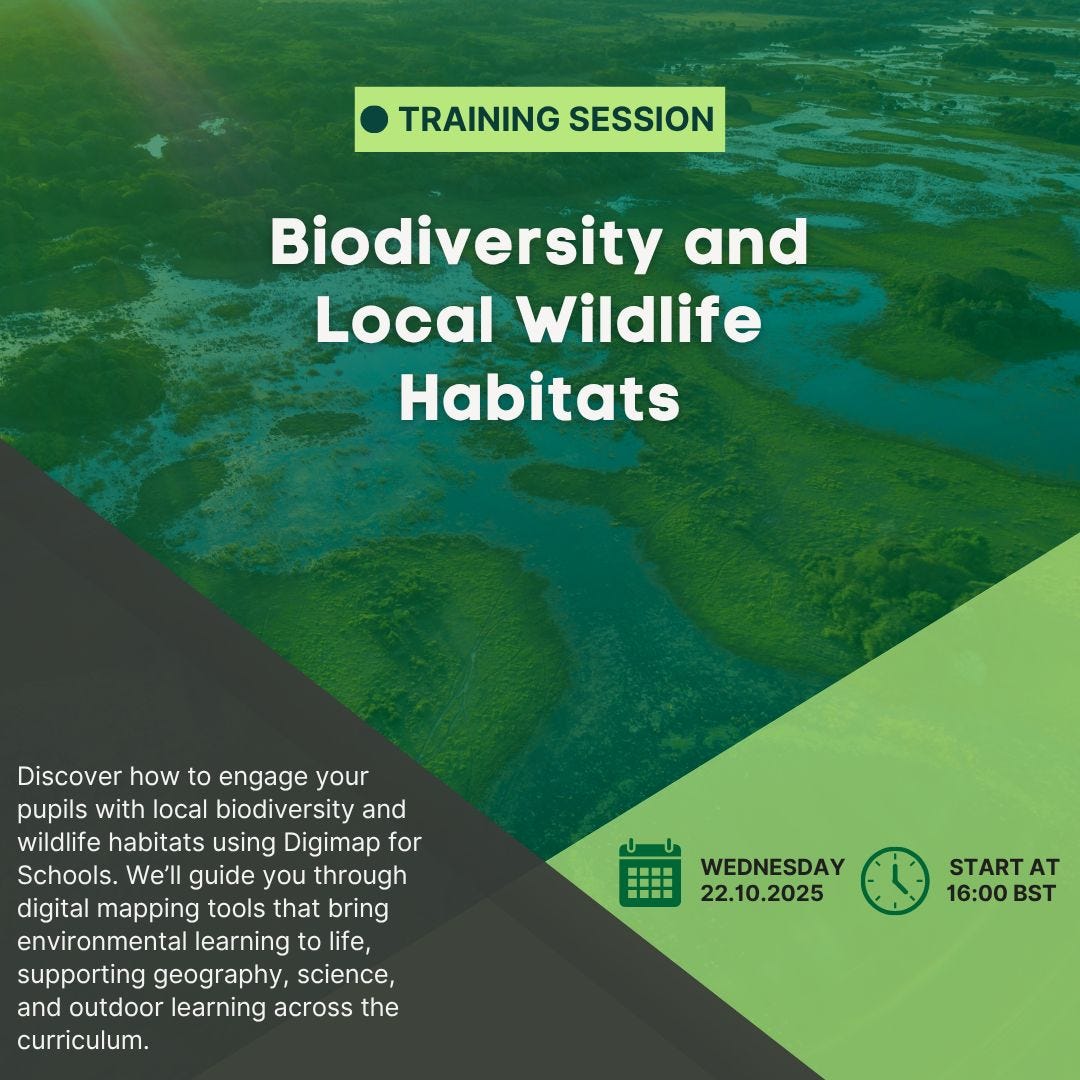
#502: Digimap CPD on mapping local wildlife and biodiversity

A free Digimap for Schools Webinar to help you explore biodiversity and local wildlife habitats. 

This sort of CPD will be valuable for those who have aspirations to teach the new specification.

No alternative text description for this image

Sign up here - it’s free.

Tuesday, 7 October 2025

#501: Green to Grey

Green to Grey tracks environmental change in the EU.


Here's the opening shots of the website which includes a wealth of information and imagery on environmental change. Would go well with Daniel Raven Ellison's 100 Seconds films.

The website has many stories and details of specific locations.
It was featured in this recent Guardian piece outlining the rate of change of the environment. We often talk about deforestation in the Amazon, forgetting that we are degrading the landscape here in Europe, and even more so in the nature-depleted UK.

Thanks to Alice Griffiths for the tipoff here.

Monday, 6 October 2025

#500: Still waiting...

When I started this blog back in January 2023 it looked like we might have a draft specification for the GCSE Natural History fairly quickly... we had had the original draft consultation and OCR were taking up the task of developing some resources and other support materials.

Image: Alan Parkinson, shared on Flickr under CC license

A new specification would need all the related documents, including sample assessment materials (SAMS), materials and training for teachers who might be considering teaching the course, a textbook perhaps and support for schools who might decide to go with a new and unknown course, compared with a subject like Geography which was well known and had all the support materials in place already (presumably). 

With the fieldwork that is going to be involved in the new qualification, this was going to need some additional thinking and this may also be one factor influencing schools given the cost of some fieldwork.

The National Education Nature Park has done a lot of work in this area promoting local and school-based work.

Still waiting then... and hoping that the next OCR Consultative Forum meeting may offer some news...  although unfortunately it's been scheduled for a day I can't make.

Friday, 3 October 2025

#499: The Boar: a timely piece

Via my Google Alert that I set up for the term 'GCSE Natural History' is a piece in The Boar by Megan Denham.

Founded in 1973, The Boar is the University of Warwick’s award-winning student newspaper and the only student-run print newspaper on campus. 
The paper is run by students, for students and all editorial board and business team positions are voluntary. With a reach of approximately 33,000 students and staff on campus, the newspaper is printed monthly during term time.


It points to a general lack of climate change mentions in the curriculum, which doesn't mean it isn't taught of course. My school doesn't follow the national curriculum along with a great many others...

On the GCSE Natural History as a possible addition, it says:

In an attempt for greater climate inclusion, a new Natural History GCSE is being introduced across the UK – the result of a campaign led by naturalist Mary Colwell. The government says: “The new Natural History qualification will enable young people to explore the world by learning about organisms and environments, environmental and sustainability issues, and gain a deeper knowledge of the natural world around them.”

On the surface, this seems to be a significant step toward integrating more in-depth climate education into secondary schools. On the other hand, the efficacy of the course relies on its uptake by students (although the research by Mental Health UK suggests that there would be many students open to learning more about climate change). The implementation of the course also requires teaching staff able to deliver the content across all UK secondary schools, and, fundamentally, it does not address the UK-wide lack of cross-curricular climate education.

Monday, 29 September 2025

#498: New from Bloomsbury - 100 Ideas series - "Greener School"

New out from Bloomsbury for September and looks to be useful...
I have a copy on order....

100 Ideas for Primary Teachers: Greener School is the guide that schools need to implement and achieve their Climate Action Plans. Linking with the DfE Sustainability Climate Change Strategy, as well as the Eco-Schools' top ten topics and the Let's Go Zero Objectives, this is the essential book for creative activities that schools can use throughout the year to empower children and support teaching and learning of sustainability topics.

This book will equip primary teachers with practical ideas and knowledge of resources across a range of environmental topics, including litter, marine life, biodiversity, energy, school grounds and transport. It will cover how schools can reduce their waste, save money and even make money through practical campaigns!

With a foreword from Dr. Jane Goodall, DBE.
Update
Just arrived... will post a better review but this looks excellent with plenty of quick ideas to action.

#721: Get your Grubby Guide

Via Tom Morgan Jones , who illustrated the Mission:Explore books that we worked on together. He has now worked with NatureScot on a Grubby G...